Eldoria · a party game for the TV
How to play
Hunt
Two teams. Everybody hides somewhere in the house and writes two clues about where they are. Then two of you go up on the TV at a time — one from each team — and everybody else gets one guess. Your team scores only if your team gets it and the other team doesn't. So the clue that wins this game is the one your friends can read and strangers can't.
The whole game in one rule
Be obvious to your friends and useless to everyone else
Your clue goes up on the TV where both teams read it, in the same second, with the same clock. There's no private channel and there never is one. The only edge your own team has is that they know you.
So every clue is a trade, and it's a trade with two bad ends. Too vague and nobody reaches you and nobody scores. Too sharp and an opponent gets there — and then they take the points instead of you, not as well as you.
42 places. Nobody scores. Including you.
22 places. Getting warmer, still a lot of doors.
4 places. Everyone gets this. Which means they do.
One place, to one person. Nothing on the tag list can do this.
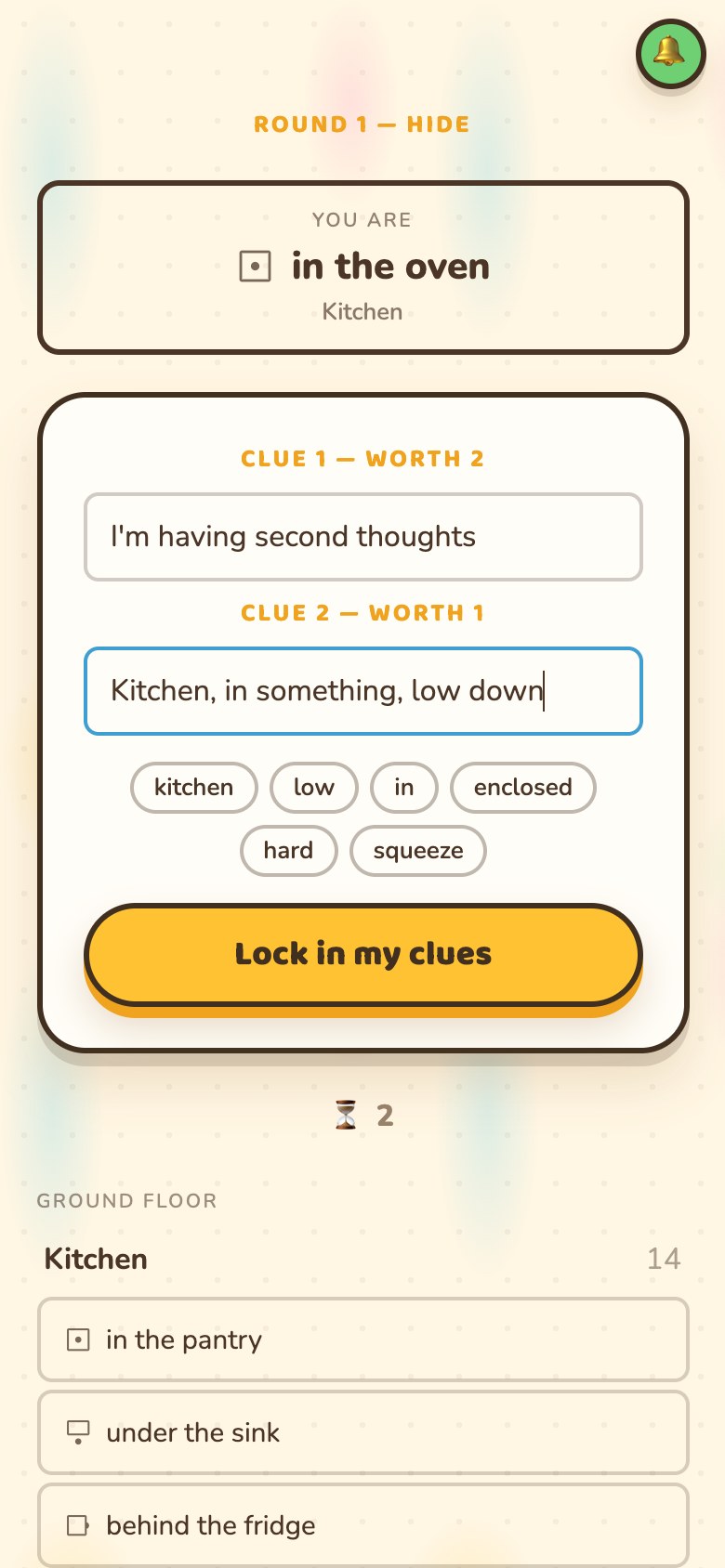
Every hiding place has a floor, a room, a height, a kind of place (in, under, behind, on top of) and a few qualities (soft, hard, damp, warm, dark, enclosed, a squeeze). Your phone lists the true ones and you can tap them straight in. They're a floor to stand on when nothing clever arrives — never the ceiling. Name the room and two attributes and you're down to about two places, which is exactly the clue everybody in the room can solve.
Setting up
Getting everyone in
Open Hunt on the TV
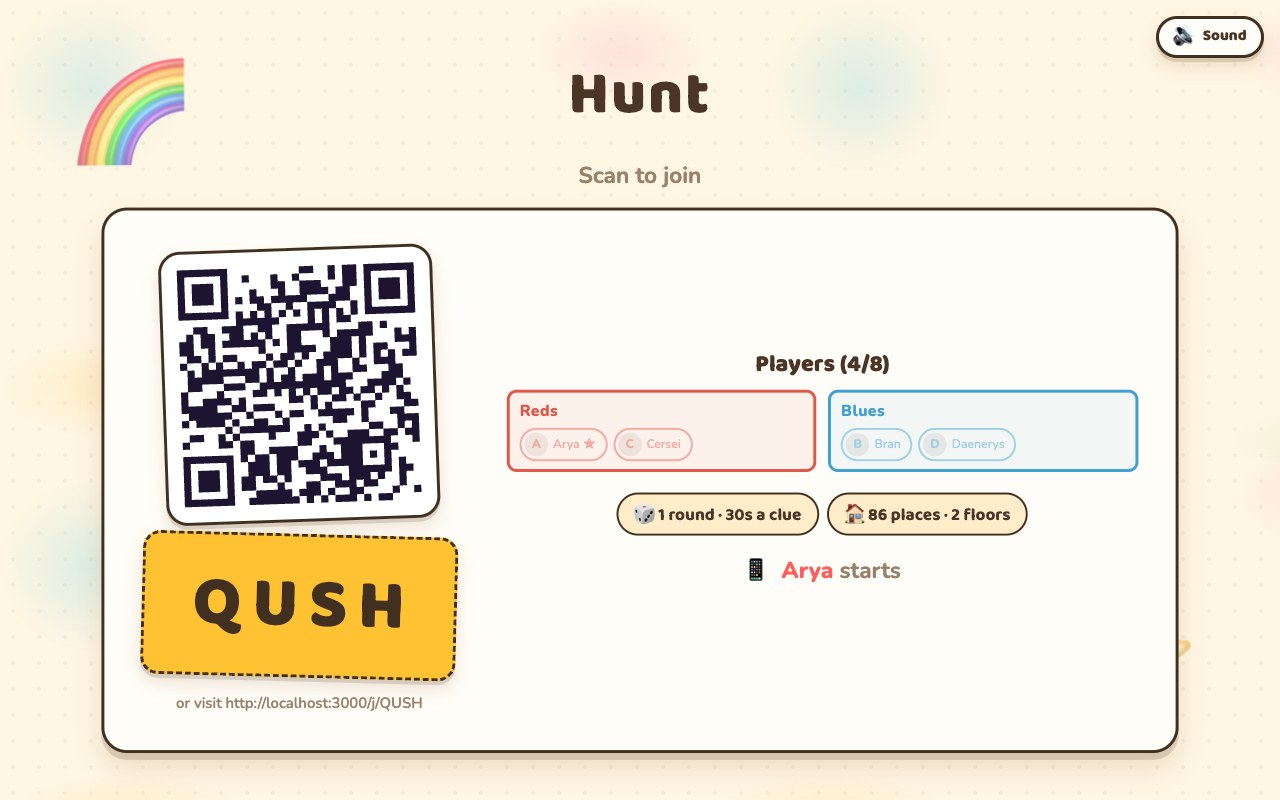
Pick Hunt from the party-games home screen. The TV shows a four-letter room code and a QR code — that's all anyone needs.
Everyone joins, and the teams split themselves
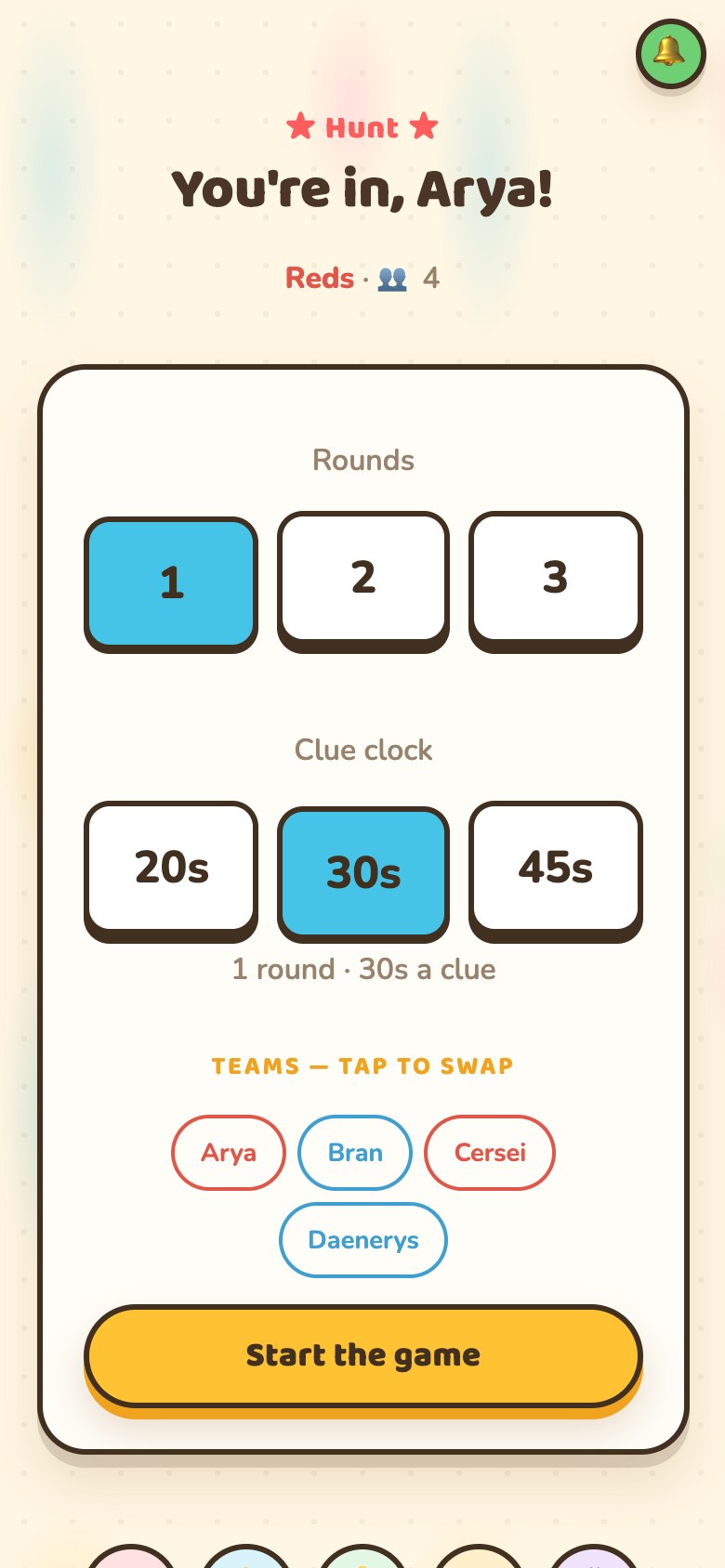
Scan the code, put in a name, and you're in. Teams alternate by join order — Reds and Blues — so nobody has to pick sides. The host can tap any name to move them across if the split put both parents on one team.
The host also sets two dials: how many rounds, and how long each clue stays up (20, 30 or 45 seconds).
The house grows with the crowd
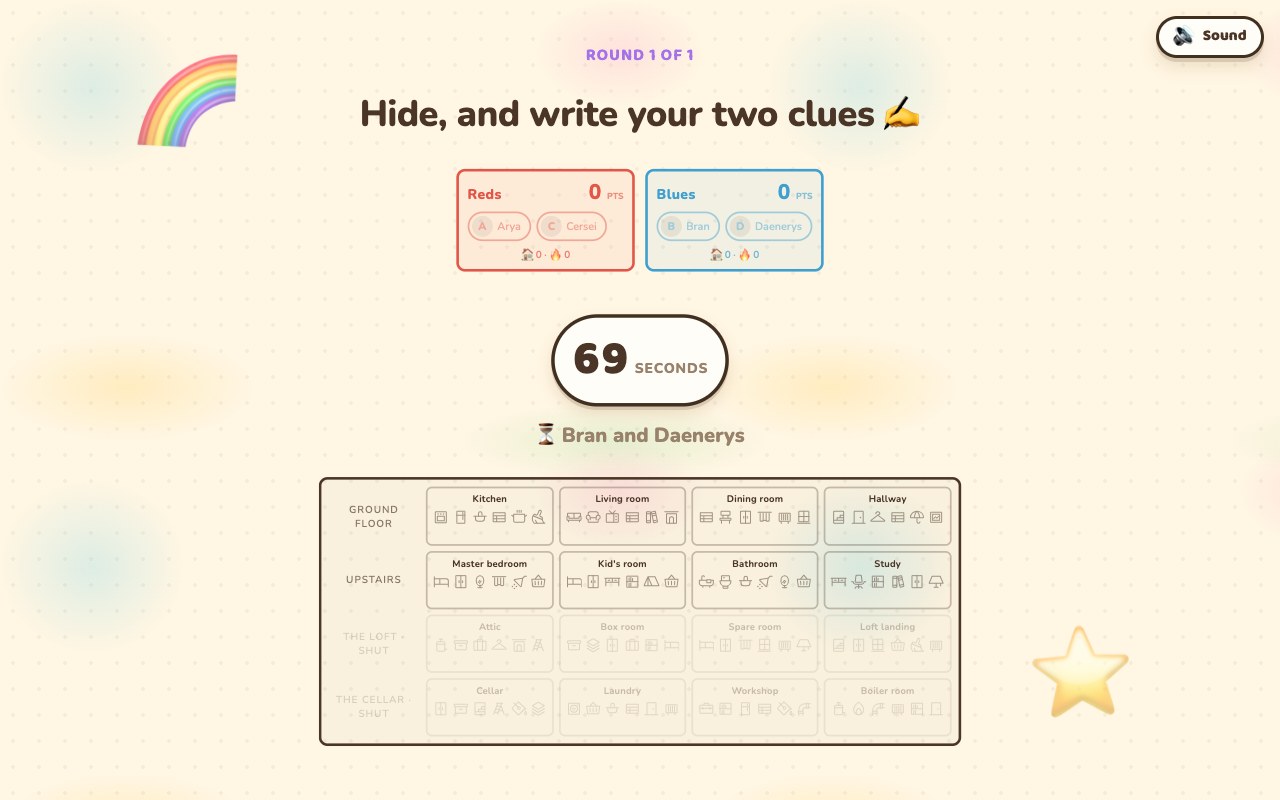
Four players get the ground floor and upstairs. Six opens the loft. Eight opens the cellar as well — sixteen rooms and 164 hiding places. Closed floors are drawn on the TV, greyed and marked shut, so you can always see what's out of bounds.
It's the same house every game. That's on purpose — by the third round of the night your team has private shorthand for half of it, and private shorthand is the whole point.
A round, start to finish
Hide, write, guess
Hide and write — 75 seconds
Pick a room, then pick a place in it. Then write your two clues: a vague one and a sharper one. Nobody sees either until you're up.
You're allowed to share a hiding place. Two of you behind the same sofa is legal, and a genuinely funny way to lose both spotlights.
Run the clock out and the house writes your clues for you, off the true facts about where you are. Competent, never inspired — and never worth waiting for.
Two go up — one from each team
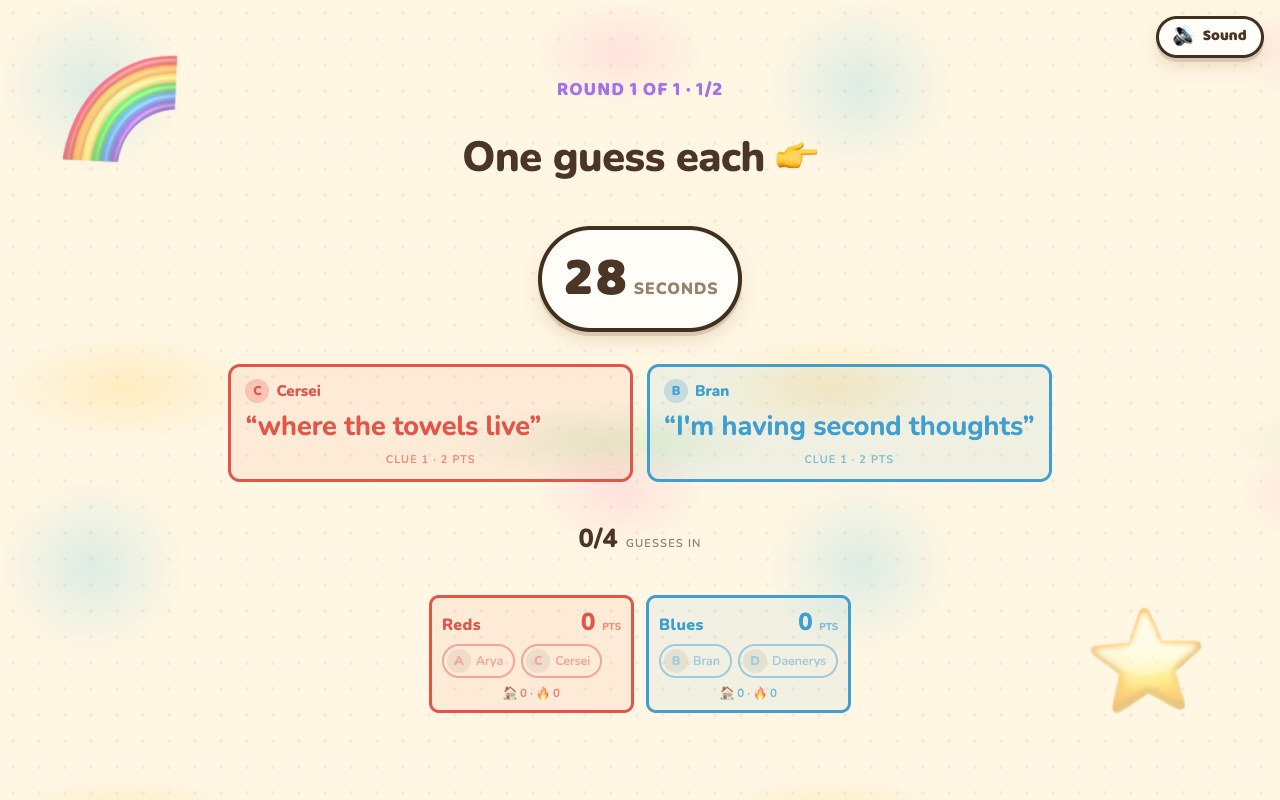
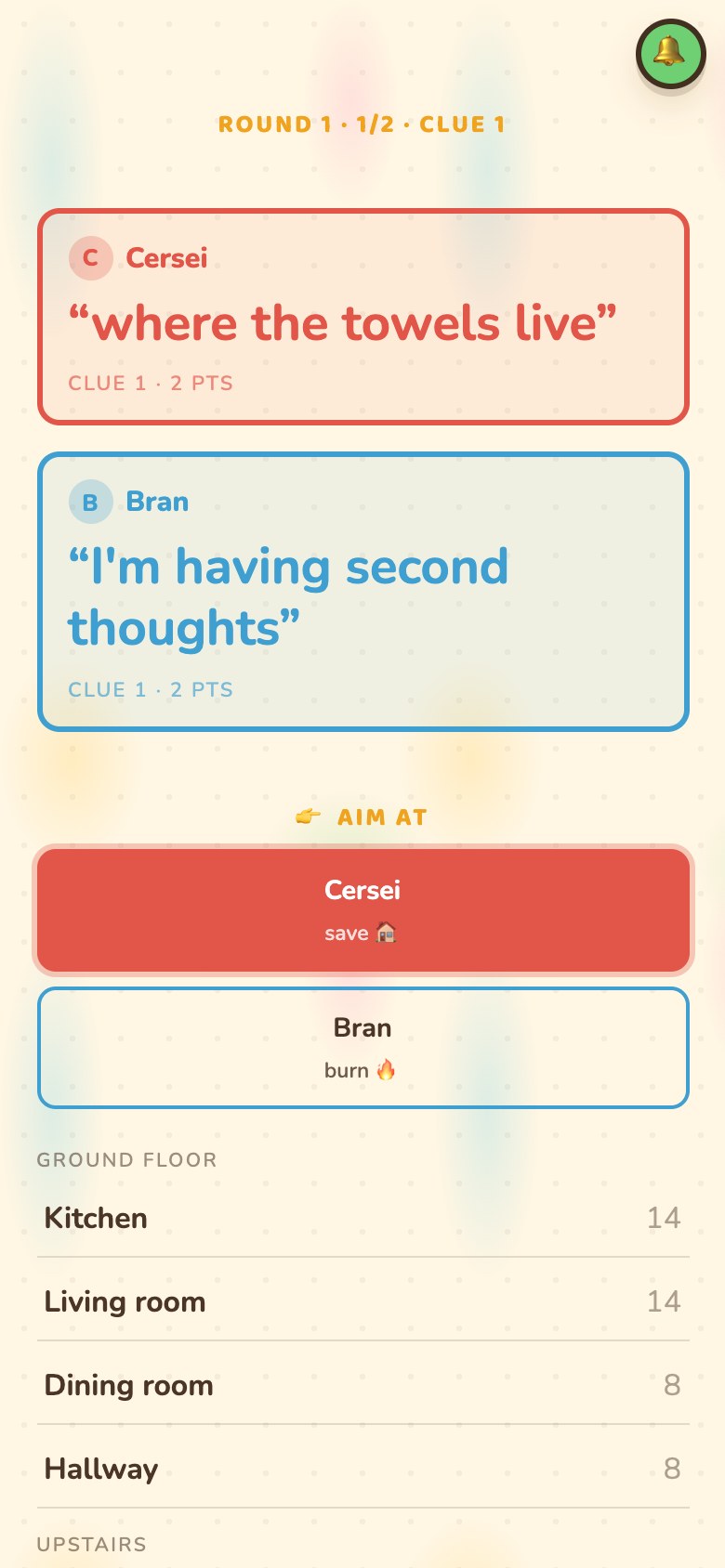
The TV shows two first clues side by side, one per team, and starts the clock. You get one guess — and it's one guess total, not one each.
- Guess your teammate's spot and you're covering them: a save.
- Guess your opponent's and you're taking their points: a burn.
You can't do both. Going for the burn is cover you didn't give — which is what makes the choice worth making, and why the TV puts both clues in front of you at once.
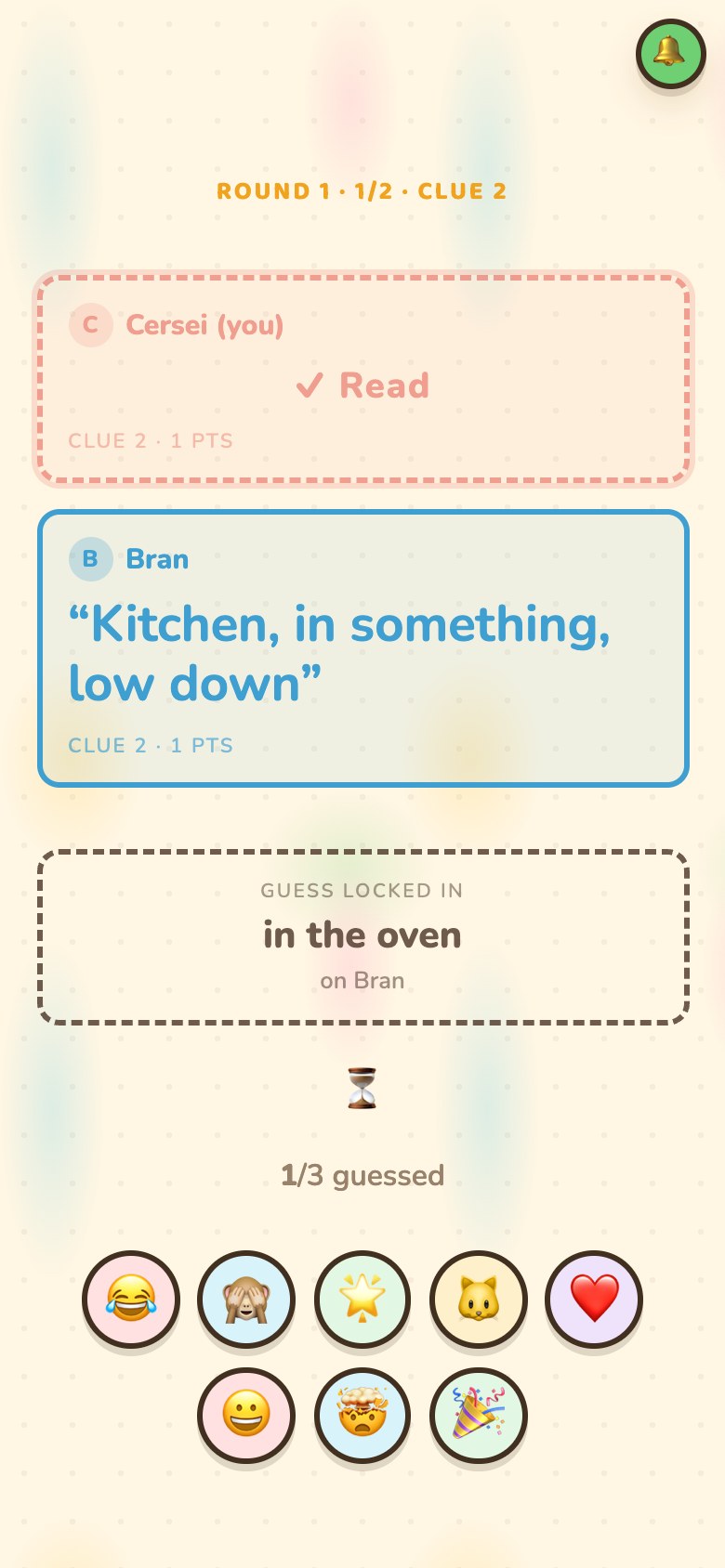
Nobody learns anything until the clock runs out. Not who guessed, not what they guessed, not whether anyone was right. If you're one of the two up there, you still guess — at the other one.
Then the second clue, worth half
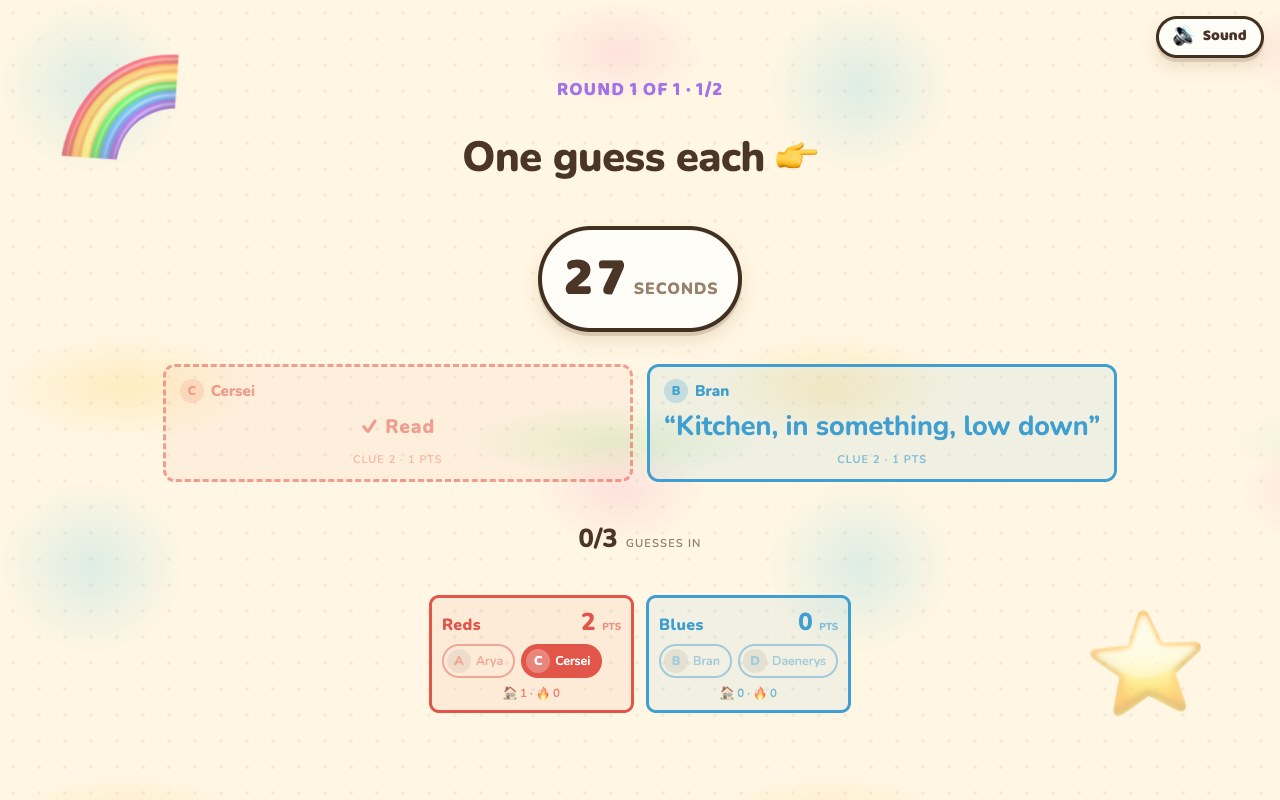
Anyone nobody got drops their second clue and the clock runs again — but now the spotlight is only worth 1 instead of 2. Everybody gets one fresh guess.
Somebody already read on the first clue sits the second one out. Their card goes grey and says Read — and nothing else, because the reveal is still to come.
Who gets the points
Saved, burned, or nobody
When the clock stops, every guess is opened at once and each spotlight settles one of three ways.
Your team scores the clue's value. This is the good one, and it's the only one you can aim for.
They score it. You score nothing — however many of your own teammates also got there.
No points to anybody. Which is better than being burned, and worse than being read.
That middle rule is the one to hold on to: a burn beats a save on the same clue. Being findable isn't the goal — being findable selectively is.
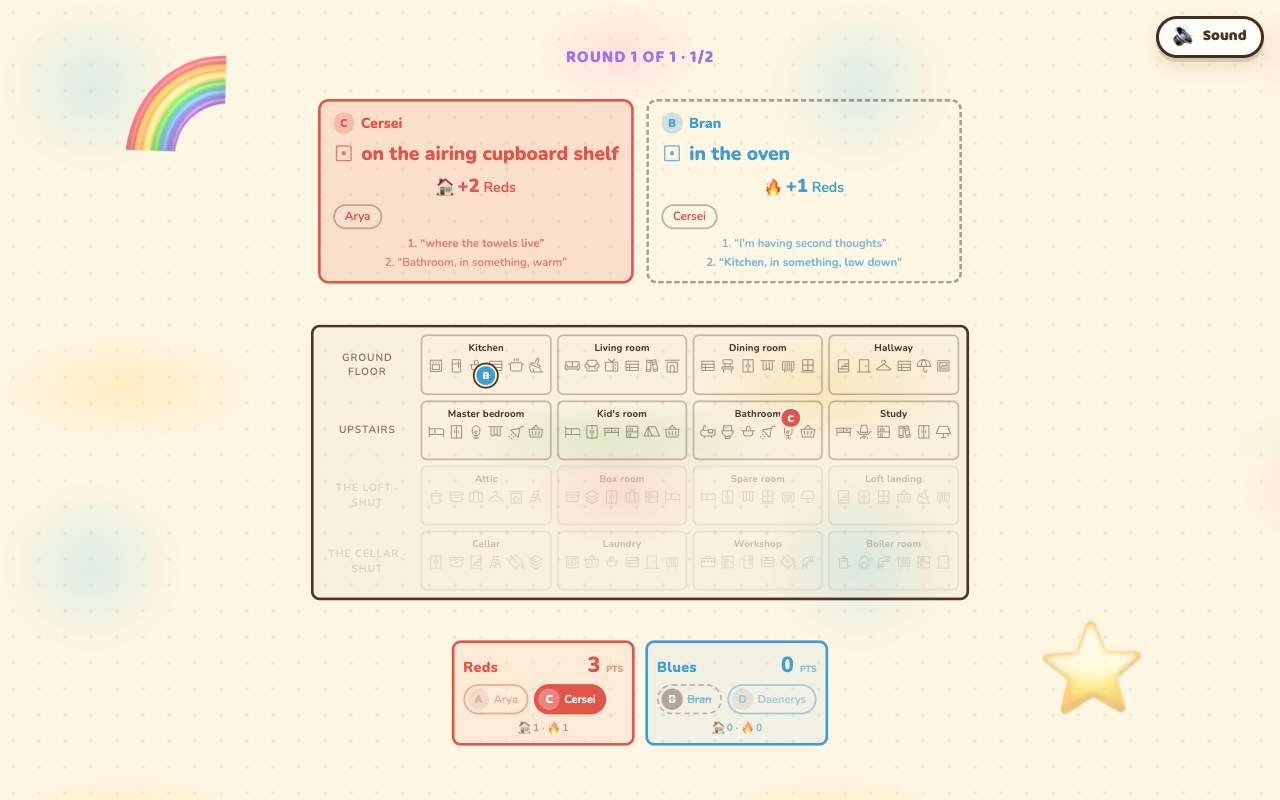
Then the TV shows both hiding places, both clues, and who read them. This is the screen that makes the next round better: you find out that "somewhere damp" meant the bath, and that Daenerys has now hidden in the wardrobe twice.
Winning
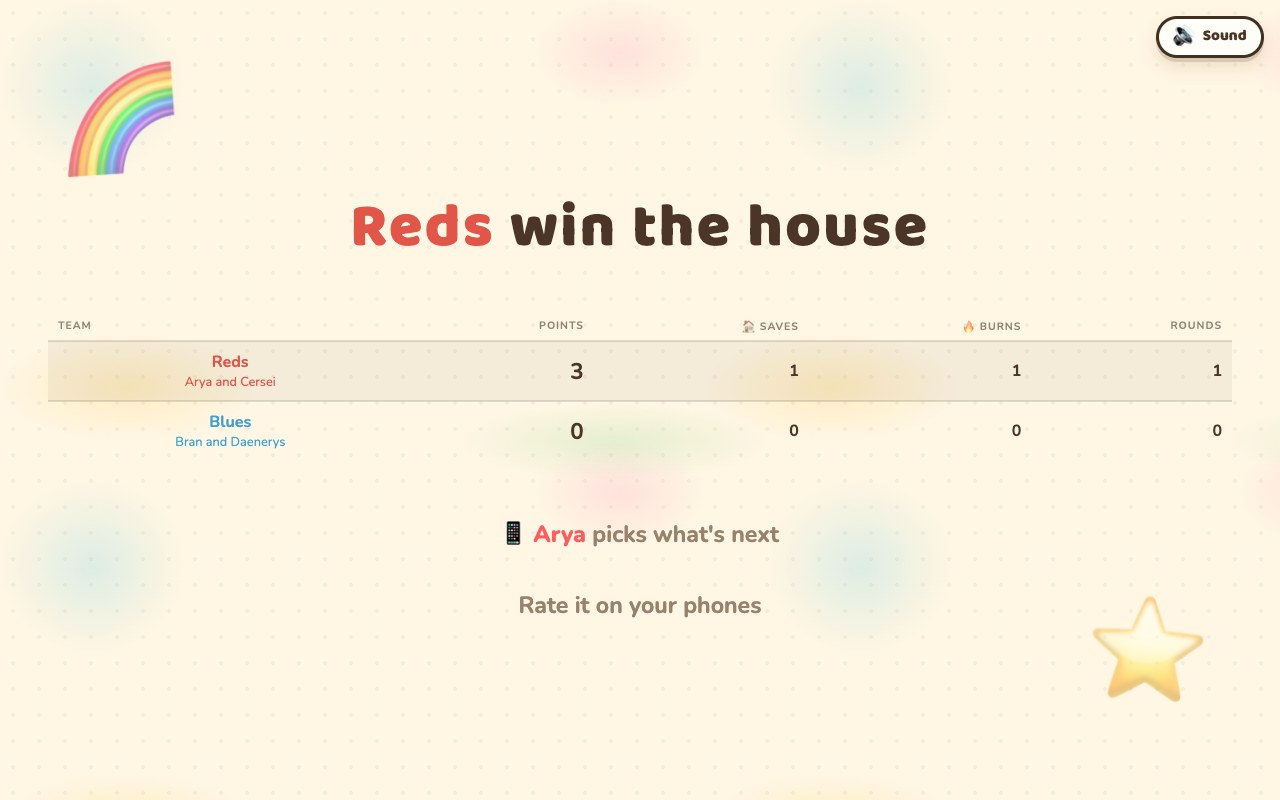
Most points takes it
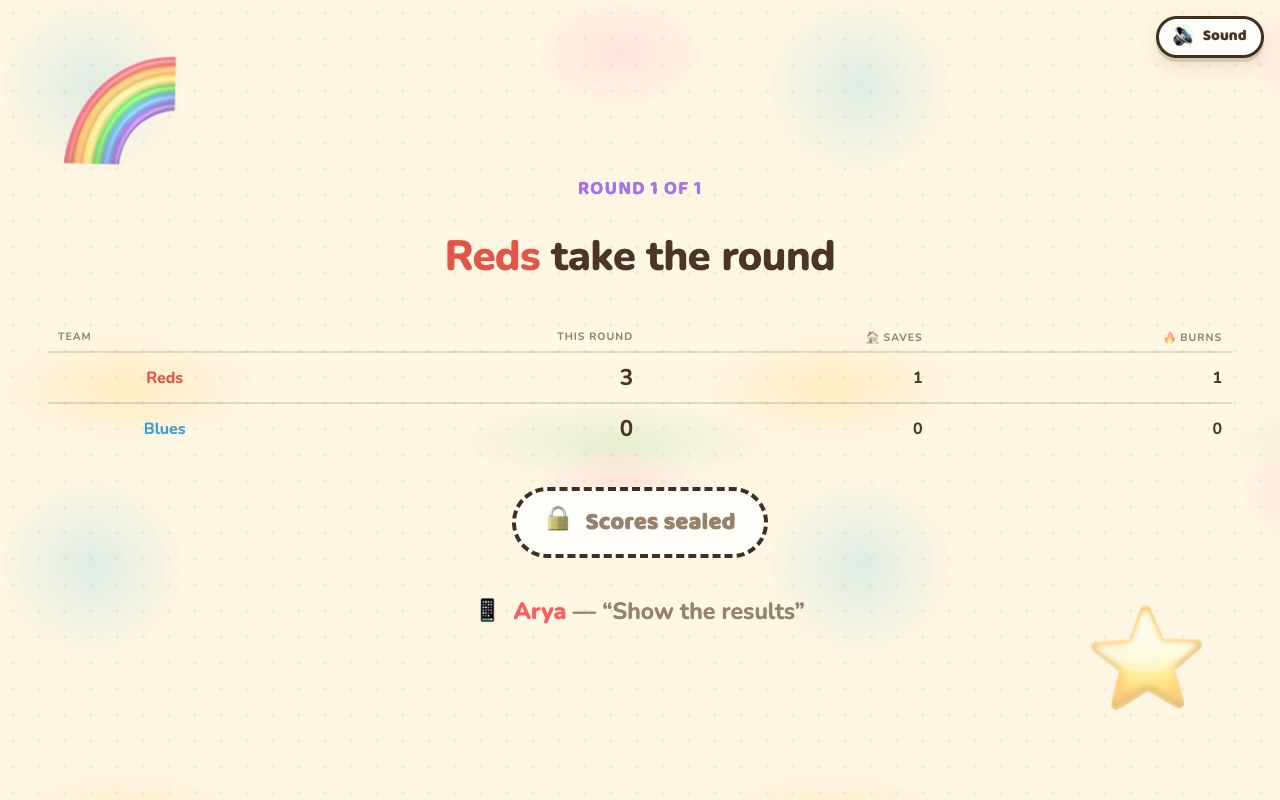
Everybody is spotlit exactly once a round, one pair at a time, so both teams get the same number of goes and there's no bad draw to be unlucky with. Add the points up across every round; the biggest total wins the house.
Level on points, it goes to saves — the times your own team read you and nobody else did. Which is a fair way to break a tie in a game about knowing your friends.
An odd number of you
The dog
Five, seven — somebody's team is a player short, which would leave the pairs out of step and somebody never spotlit at all. So the short team fields the dog: an extra character, hidden by the house, that takes the spare spotlight.
Its two clues are written by the house off the true facts about where it is. That makes it the one spotlight in the game where neither team has an edge — no shared history, no in-jokes, just how well you know the place. It scores for the short team like anybody else, and either team can burn it.
In short
The seven things to remember
- Hide somewhere, then write a vague clue and a sharper one.
- Both teams read your clue, at the same time, on the same TV.
- Your team scores only if your team gets it and the other lot don't.
- The first clue is worth 2; the second is worth 1.
- One guess a clue, and two people are up — save your own, or burn theirs.
- The tag chips are a floor. The clue that wins is the one only your lot get.
- Everybody goes up once a round. Most points across the game wins.