Eldoria · a party game for the TV
How to play
Kalookie
Rummy with a contract to fill. Every round names the melds you have to put on the table — three sets, then two sets and a run, and so on — and you have to lay all of them down in one turn or none of them. Then you shed what's left. And here's the part that isn't in the rulebook: when somebody throws a card away, the rest of the table can bid for it.
The whole game in one picture
Every turn is two halves, and everybody plays both
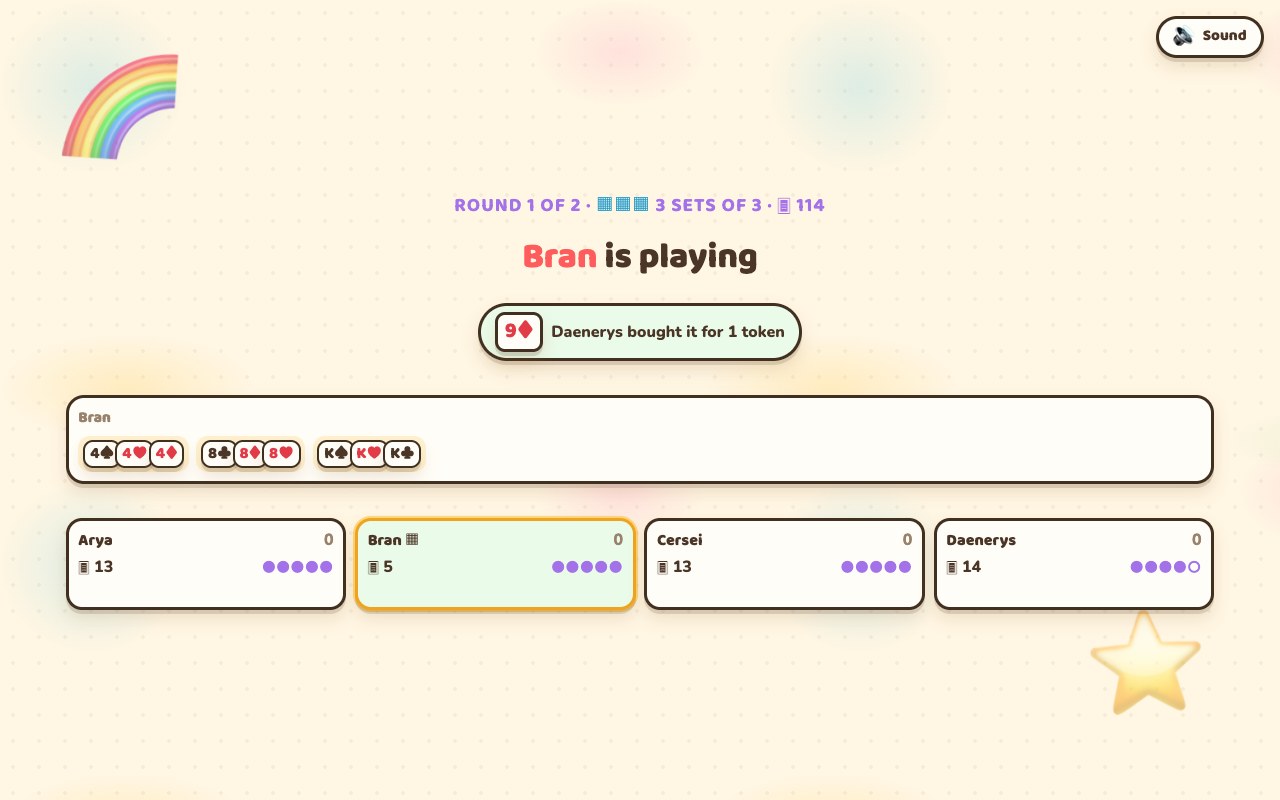
Most card games make seven people watch one person think. This one doesn't. A turn opens with the card on top of the discard pile going up for auction — and everybody has something to do about it — before the player whose turn it is gets on with their turn.
So the table acts on every single turn, and the good discard — the one you'd have loved — now costs somebody something. Tokens come back with every deal, so a token you never spend is a token you wasted.
The building blocks
Two kinds of meld, and nothing else
Everything you ever put on the table is one of these two things. A set is one rank in different suits. A run is one suit climbing consecutive ranks.
Two limits are worth knowing before you start collecting, because they're the ones people trip over:
Wild cards
A joker stops being wild the moment it's on the table
In your hand a joker is anything you like. Put it in a meld, though, and it becomes one specific card — the one the gap wanted — and the screens draw it wearing that card, because from then on it matters exactly which one it is.
Which is what makes the next rule possible: if you're holding the exact card a joker is standing in for, you can buy it back — hand over the seven of spades, take the joker into your hand, and spend it again on something of your own. The seven of hearts won't do it.
A meld can hold more than one joker, but never only jokers: there has to be a real card in there. And a joker left in your hand when somebody goes out costs you 25, more than anything else in the deck.
The point of it all
The 4 contracts, in order
One per round, and everybody plays the same one. You can't work on a later contract, and you can't lay half of this one down and finish it next turn — it goes down whole, in a single turn, or it waits.
| Round | What you have to lay down | Cards |
|---|---|---|
| 1 | 3 sets of 3 | 9 |
| 2 | 2 sets of 3 + 1 run of 4 | 10 |
| 3 | 1 set of 3 + 2 runs of 4 | 11 |
| 4 | 3 runs of 4 | 12 |
You're dealt 13 every round and draw to 14 on your turn, so the last contract uses all but two of the cards in your hand. Runs get easier as the rounds go on and sets get scarcer, which is why the order runs the way it does.
Setting up
Getting everyone in
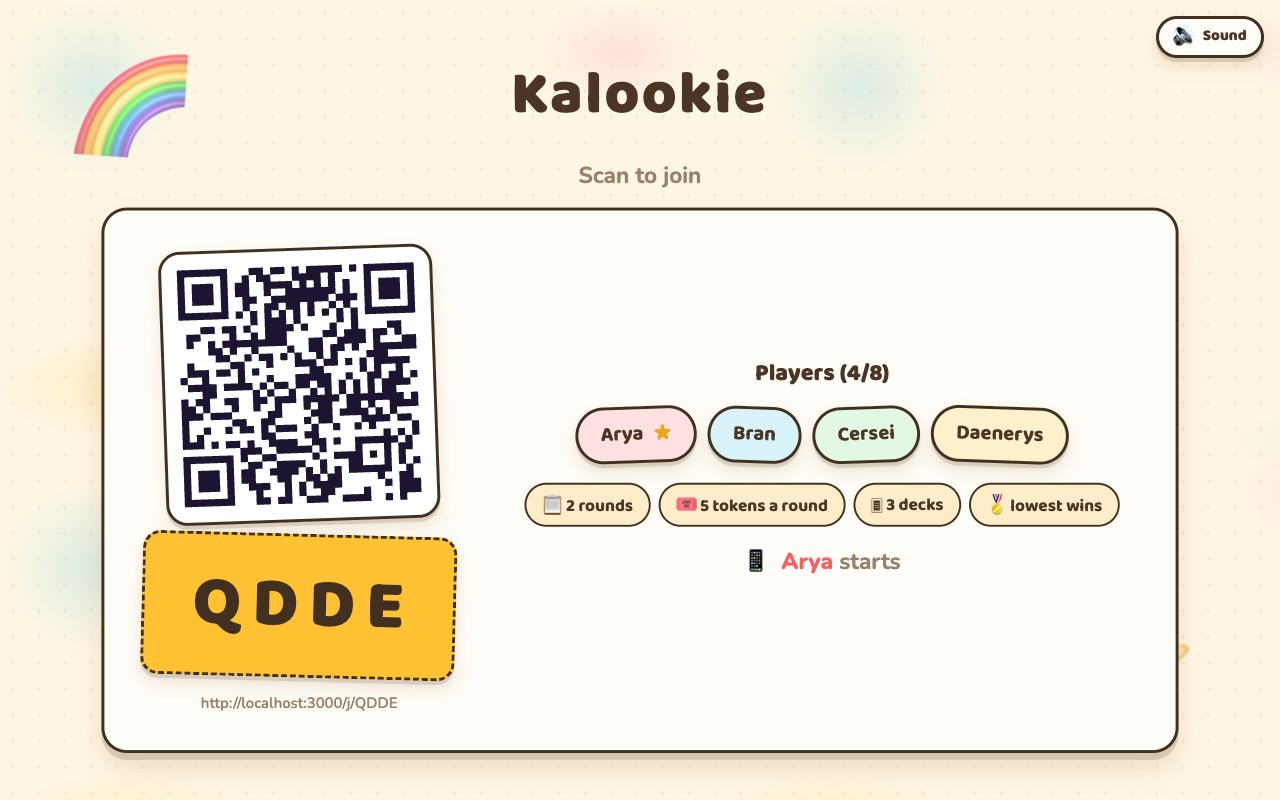
Open Kalookie on the TV
Four-letter room code and a QR code. That's the setup.
Everyone joins from their phone
Scan, name, in. Seating order is join order and it holds all game — which matters, because the player on your left is the one your discards are offered to first.
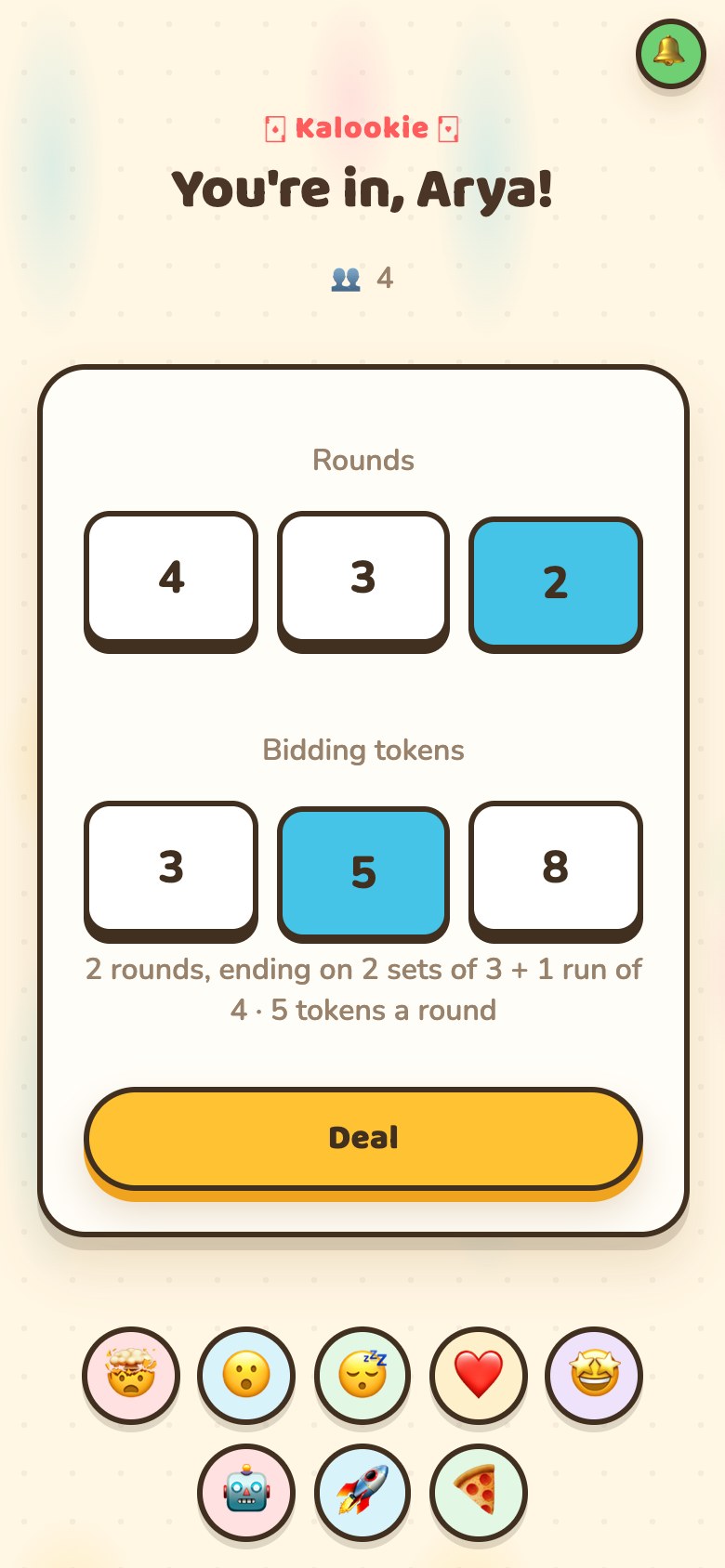
The host picks how long, and how rich
4, 3 or 2 rounds, always counted from the first — a short game is the same game with the hard rounds taken off the end. Then 3, 5 or 8 bidding tokens each, per round. More tokens means a louder auction.
Decks come in as the table grows — 2 up to three players, 3 up to six, 4 up to eight — because what has to survive dealing 13 cards apiece is the pile you're all drawing from.
The first half of a turn
Somebody threw a card. What's it worth to you?
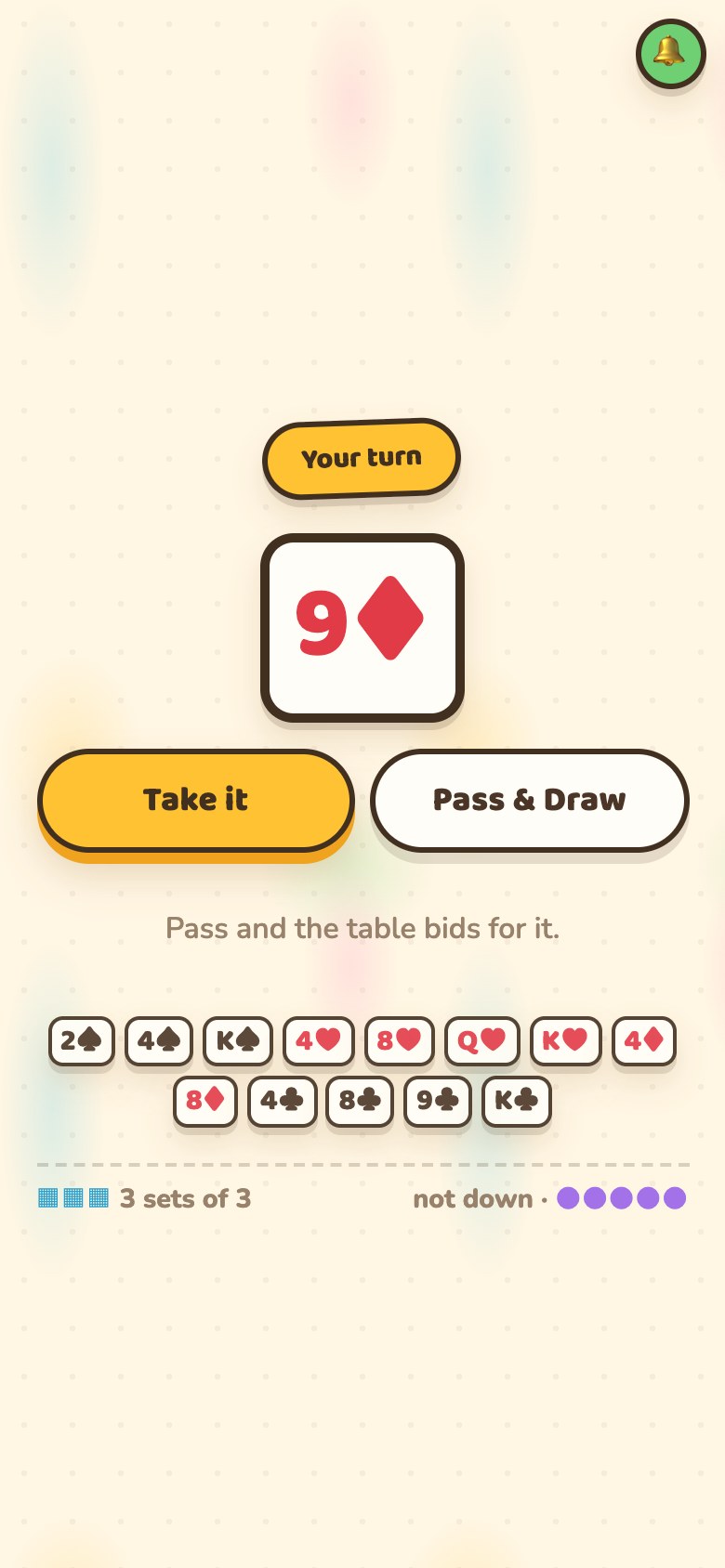
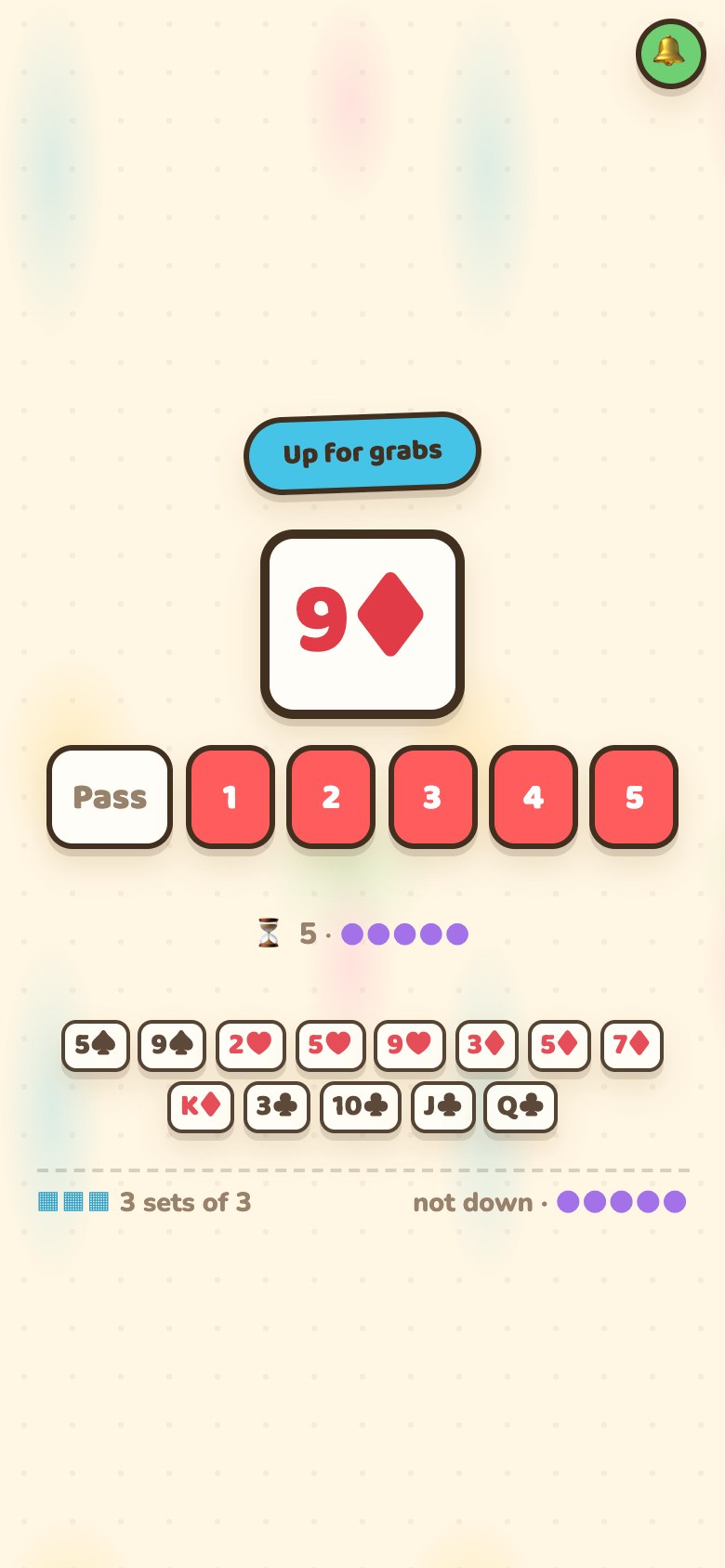
The card sits on the TV with a clock next to it. Three different screens are looking at it, and they're asking three different questions.
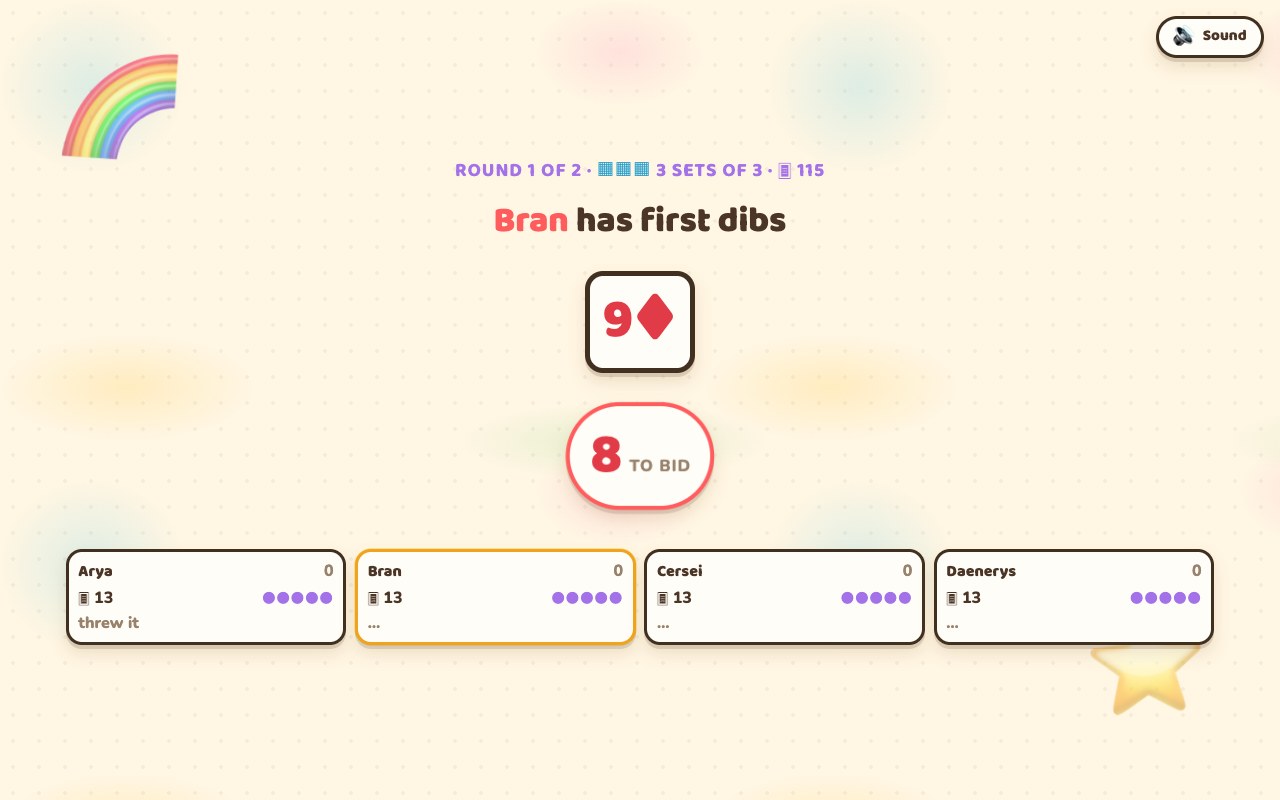
Whoever is up decides first, and pays nothing
Take it and the auction is off — the card is yours, no tokens change hands, and everybody else's bid is torn up. Pass and you draw an unknown card off the deck instead, and the table gets to fight over the one you turned down.
Which makes a pass information. Everyone just watched you not want it.
Everyone else bids blind
Up to 5 tokens, and nobody sees anybody else's number until it's over. Highest wins; a tie goes to whoever sits nearest the player who threw the card. You can't bid on your own discard, and you can't bid on your own turn — you already had the card for free.
The clock is 12 seconds, but it ends the moment everybody has answered, which is most of the time.
Winning a bid does not give you a turn
This is the part to get straight. You pay the tokens, the card goes into your hand, and play carries on as if nothing happened. So you are now holding one card more than everybody else — and since the only way to get rid of cards is to put them on the table, that extra card is the other half of the price.
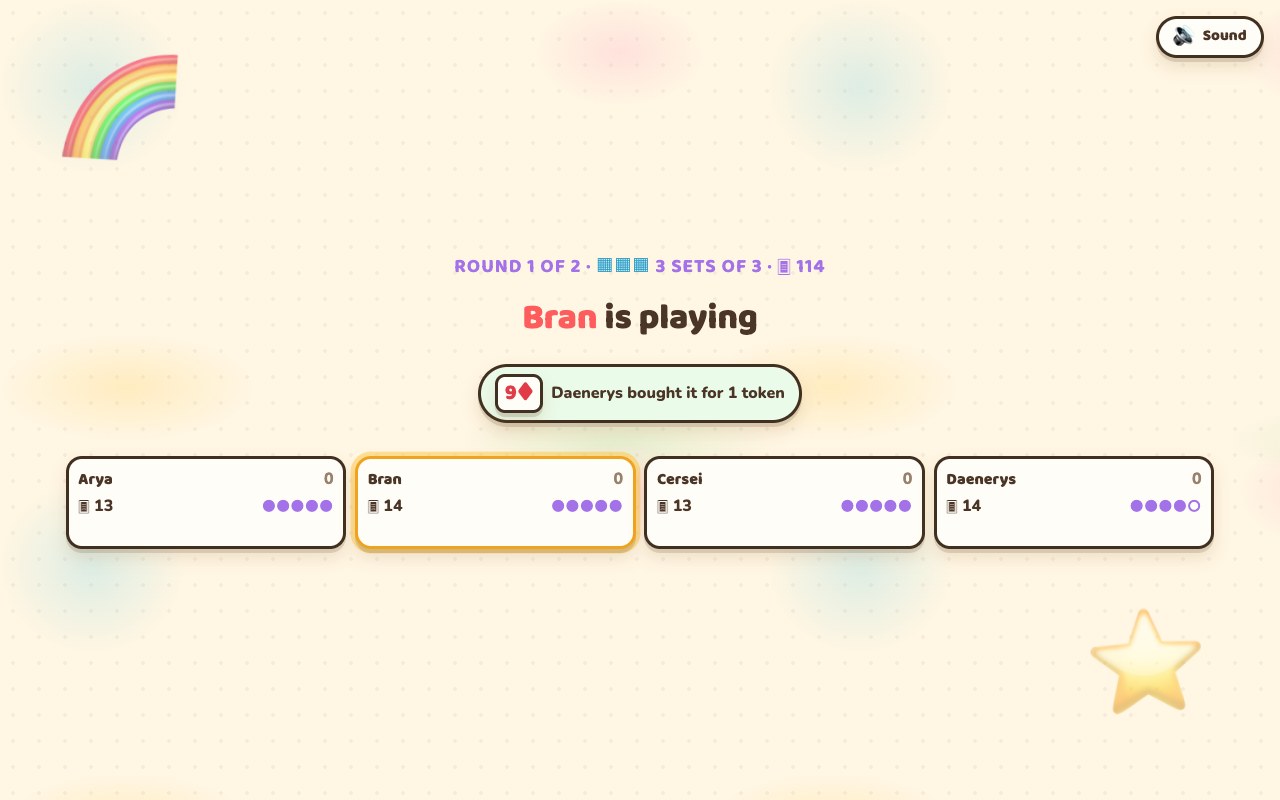
Buy a card you can use this turn and you've gained a tempo. Buy one you merely like the look of and you've bought yourself another turn's work.
The second half of a turn
Now it's just you
Lay the contract down, if it's all there
Your phone draws one empty slot per meld the round asks for. Tap cards to drop them in, tap them again to take them out, and the slot ticks when what's in it is legal. Auto-fill asks the game for the best contract in your hand and fills the slots with it — you can still take it apart afterwards, and often should.
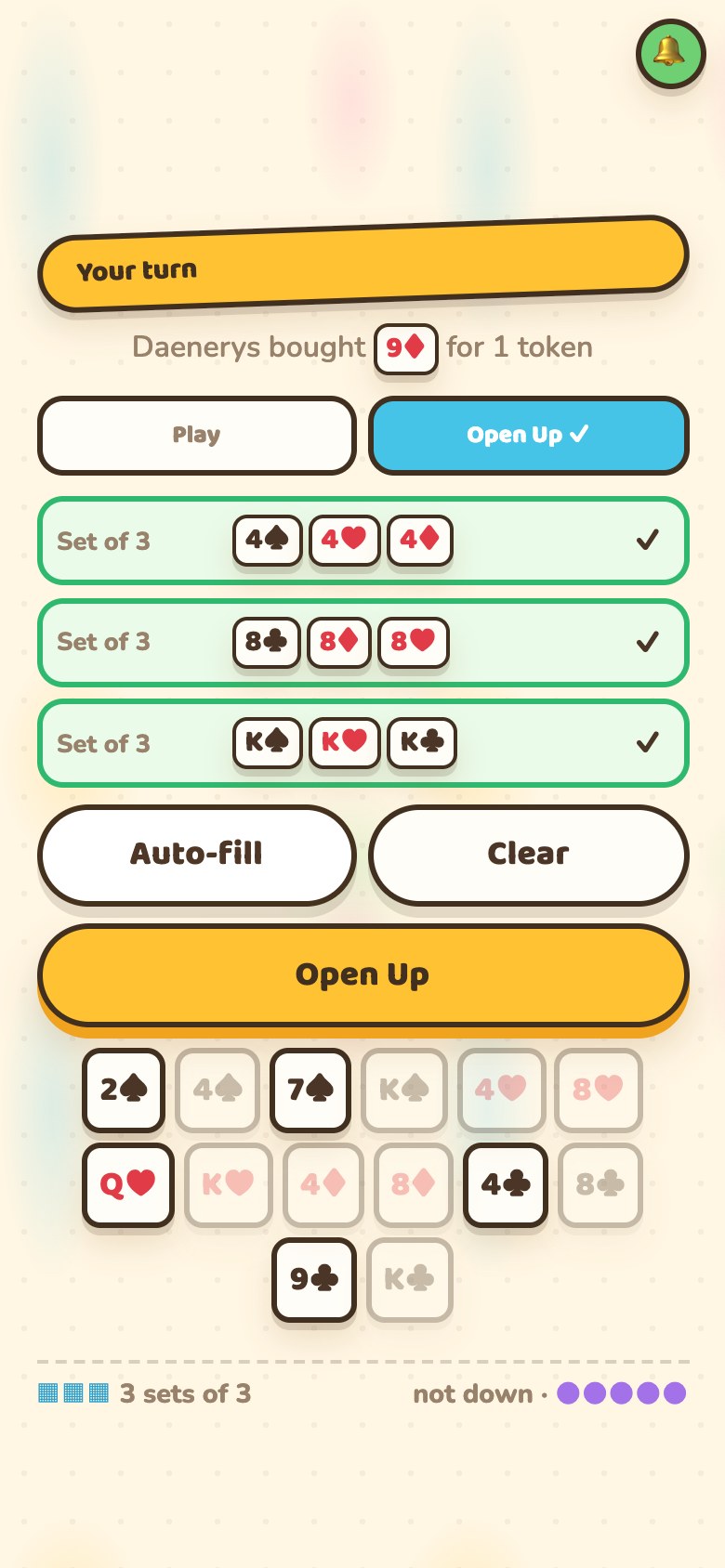
Auto-fill is stingy with jokers on purpose — it would rather leave one in your hand than spend it — so if you want to burn a joker to get down early, that's a decision it leaves to you.
Once you're down, the whole table is yours to play on
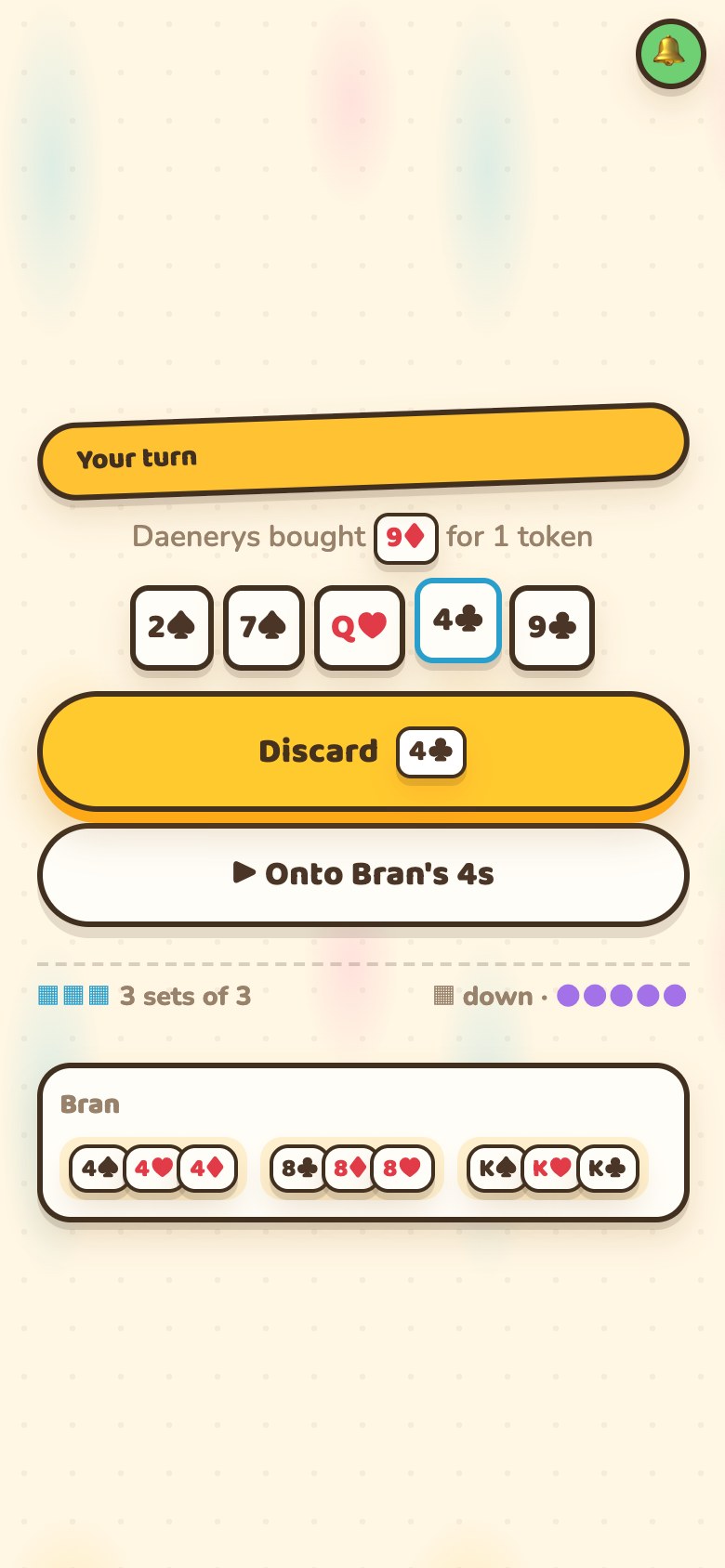
Extend anybody's run off either end. Add the missing suit to anybody's set. Swap a natural card in for a joker and pocket the joker. Tap a card in your hand and the phone shows you everywhere it can go.
Until you're down you may not touch the table at all — not your melds, not anyone else's. Collecting is all you can do.
Throw one card away. That's the turn.
Every turn ends with a discard, and that card is what the next auction is about. There's no keeping quiet: whatever you don't want, the table gets a look at.
Ending a round
Going out is a shedding problem, not a discarding one
You go out when your hand is empty, and the round stops dead the moment you do — everybody else is stuck with what they're holding, and nobody gets another turn.
Here's the thing people miss on their first game. Every turn you draw one card and throw one away, so discarding never makes your hand any smaller. The only thing that does is putting cards on the table. Sitting on two cards with nowhere to put them means sitting on two cards, turn after turn, however many you throw.
Which is why where you can put your last few cards is worth planning for while you still have plenty. A hand full of cards that match nothing on the table is a hand you cannot get out of.
When nobody can get out at all
It happens, and the first round is where it happens: three sets each and nothing else, and a set stops at 4. Once every set on the table is full there is simply nowhere left to put a card, and if everybody is already down the round can't end on its own. So it ends anyway — the pile goes back into the deck once, and the second time the cards run out, that's the round. Nobody goes out, and everybody counts what they're holding.
Scoring
Only the cards in your hand count against you
Anything you got onto the table is worth nothing, whoever it ended up helping. What you're still holding when somebody goes out is the whole of your score for the round, and it adds up across the game.
| Card | Points |
|---|---|
| 2 to 10 | face value |
| Jack, Queen, King | 10 |
| Ace | 15 |
| Joker | 25 |
| The player who went out | 0 |
So a hand of A♥ 🃏 K♣ 3♦ costs you 15 + 25 + 10 + 3 = 53. Four cards, and one of them is worth more than the other three together.
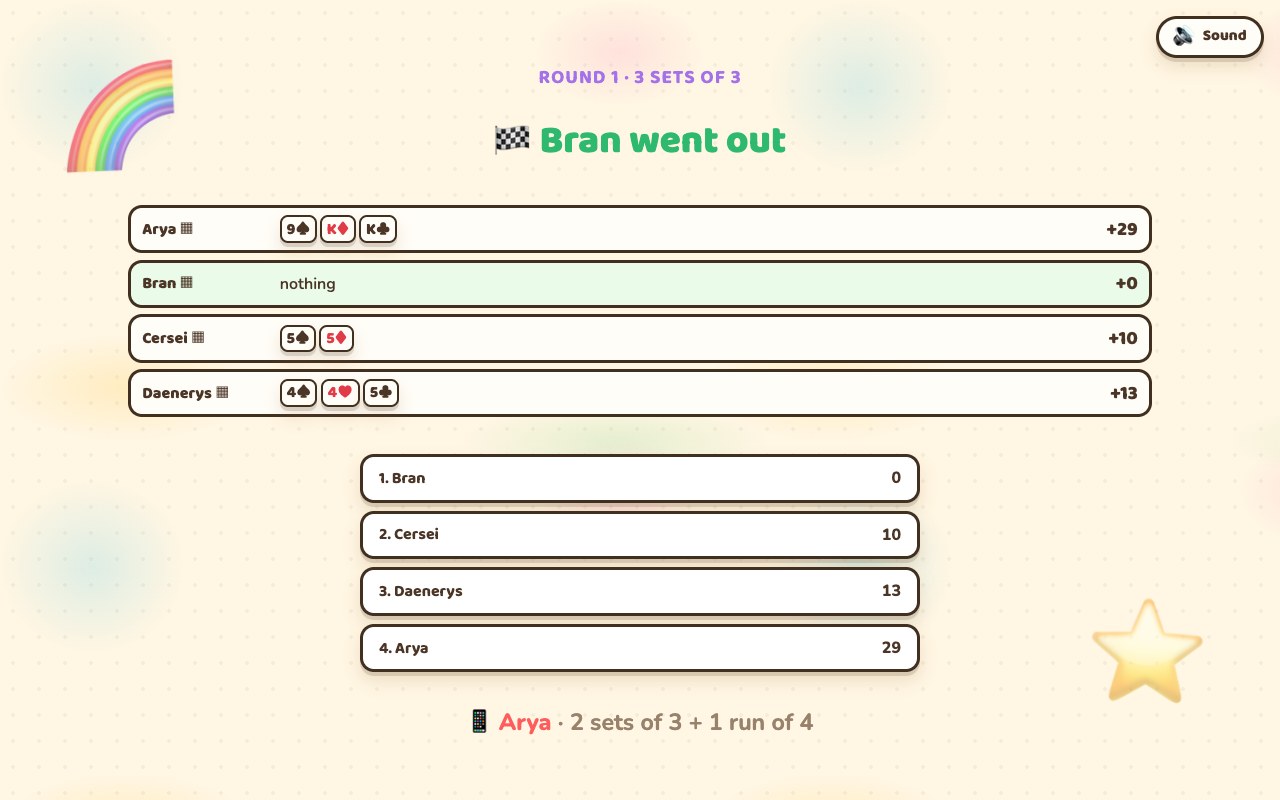
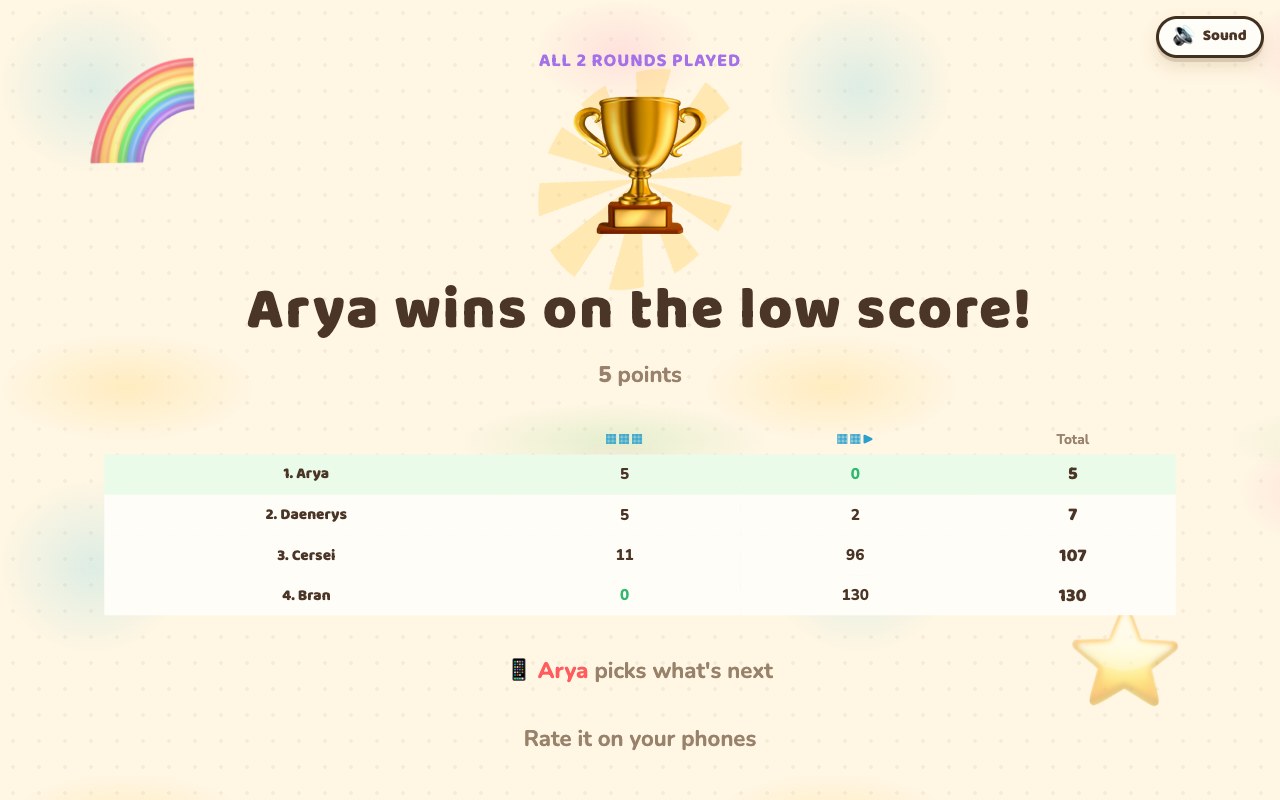
Lowest total after the last round wins. There's no prize for going out beyond the nought it gets you — but a nought while the table is holding twenty points each is most of a game.
Tips
Playing it well
Bid on cards you can play this round
A token is cheap; the card that comes with it isn't. Every card you buy is one more you have to find a home for before you can go out, so buy the card that completes something and let the merely interesting ones go.
Stop bidding the moment you're down
Once your contract is on the table you are trying to empty your hand, and a won bid puts a card into it with no turn attached to play the thing. It is the most reliable way to talk yourself out of a round you were winning.
Spend your tokens — they don't roll over
They reset with every deal. Finishing a round with 5 unspent tokens isn't thrift, it's 5 chances you didn't take.
Throw your duplicates first
Several decks are in play, so you'll be dealt the same card twice. The second copy can never join the first in a set — sets need different suits — so it's taking up a slot in your hand for nothing. Out it goes, before the kings do.
Watch what you're offering the player on your left
They get first dibs on everything you throw, free. Late in a round, check the table before you bin a card — the ten they've been waiting for is worth more to them than the ten points is to you.
Getting down early is worth more than getting down well
Nothing you're holding is safe until it's on the table, and you can't touch the table until your contract is down. A contract laid on turn six with an ugly joker in it beats a beautiful one on turn fourteen.
Keep a card that fits the table, not a card that fits your hand
Before you're down, a pair is a promising thing to hold. Afterwards it's two cards you can't play. Once you're down, keep the ones with somewhere to go and throw the rest.
Dump the joker or use it — don't nurse it
It's 25 points and the round can end on somebody else's turn. Holding one back for a run you might complete is how a good round turns into your worst score of the night.
In short
The eight things to remember
- 13 cards each, and a contract that changes every round.
- Every discard goes up for auction: whoever's up takes it free, or the rest of you bid tokens for it.
- Winning a bid buys a card, not a turn — you're simply holding one more.
- The contract goes down all at once or not at all.
- Only then can you play on the table — anybody's melds, either end of a run.
- A joker on the table is one specific card, and its owner can be bought out with it.
- Your hand only shrinks by laying off, never by discarding.
- Cards left in your hand are points against you. Lowest total wins.