Eldoria · a party game for the TV
How to play
Turf
Everybody paints the same grid at the same time. Any square two of you go for turns to mud and belongs to nobody — unless one of you already held it and painted it again, which defends it. Every 3rd round the board is counted and banked — every square you hold, plus your biggest joined-up patch counted again — and the biggest bank wins.
The whole game in one picture
One square, four outcomes
First, squares stay with whoever holds them. Second, one player painted those two squares and took them — even though somebody already had them. Third, two players both painted them, so they turned to mud: neither of them gets the squares, and whoever held them before loses them too. Fourth, the player who already held them painted them again on the same round somebody came for them, and held them — the attacker's squares were spent on nothing. Those four outcomes are the whole game.
Setting up
Getting everyone in
Open Turf on the TV
Pick Turf from the party-games home screen. The TV shows a four-letter room code and a QR code — that's all anyone needs.
Everyone joins from their phone
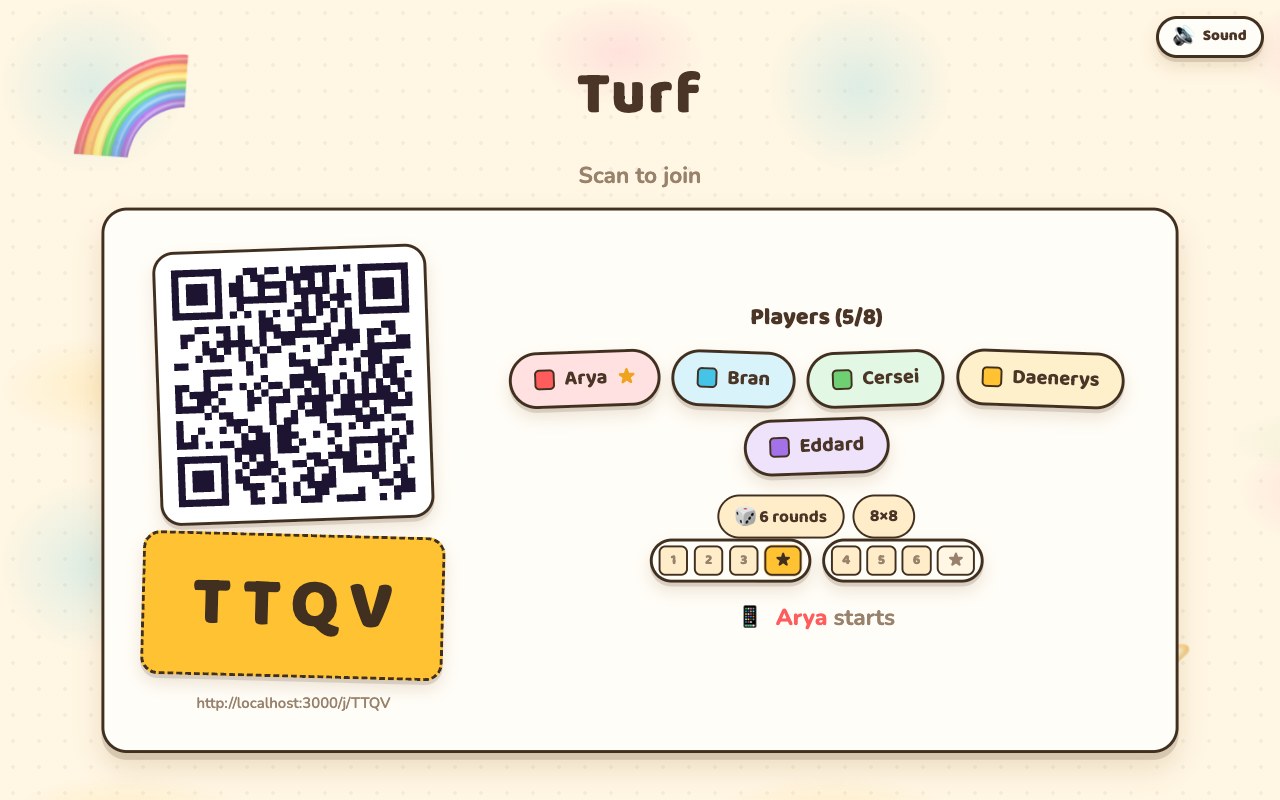
Scan the code or type the address, put in a name, and you're in. The colour beside your name in the lobby is yours for the whole game — it's the colour you'll be painting, and your initial goes on every square you hold.
The host starts it
Whoever joined first is the host. They pick the length — 6, 9 or 12 rounds — and press start. Every length divides by 3, so whatever they choose, the last round of the game is a count. Everything after that is automatic; the host only taps between rounds.
The board grows with the crowd, so it always fills at roughly the same pace whether there are two of you or eight. A two-player game counts as three, because the Grey paints as well.
| Players | Board | Squares | Painted each round |
|---|---|---|---|
| 2 + the Grey | 6×6 | 36 | 12 |
| 3 | 6×6 | 36 | 12 |
| 4 | 7×7 | 49 | 16 |
| 5–6 | 8×8 | 64 | 20–24 |
| 7 | 9×9 | 81 | 28 |
| 8 | 10×10 | 100 | 32 |
The loop
What happens in a round
Every round is the same four beats, and they take about a minute.
Three shapes go up
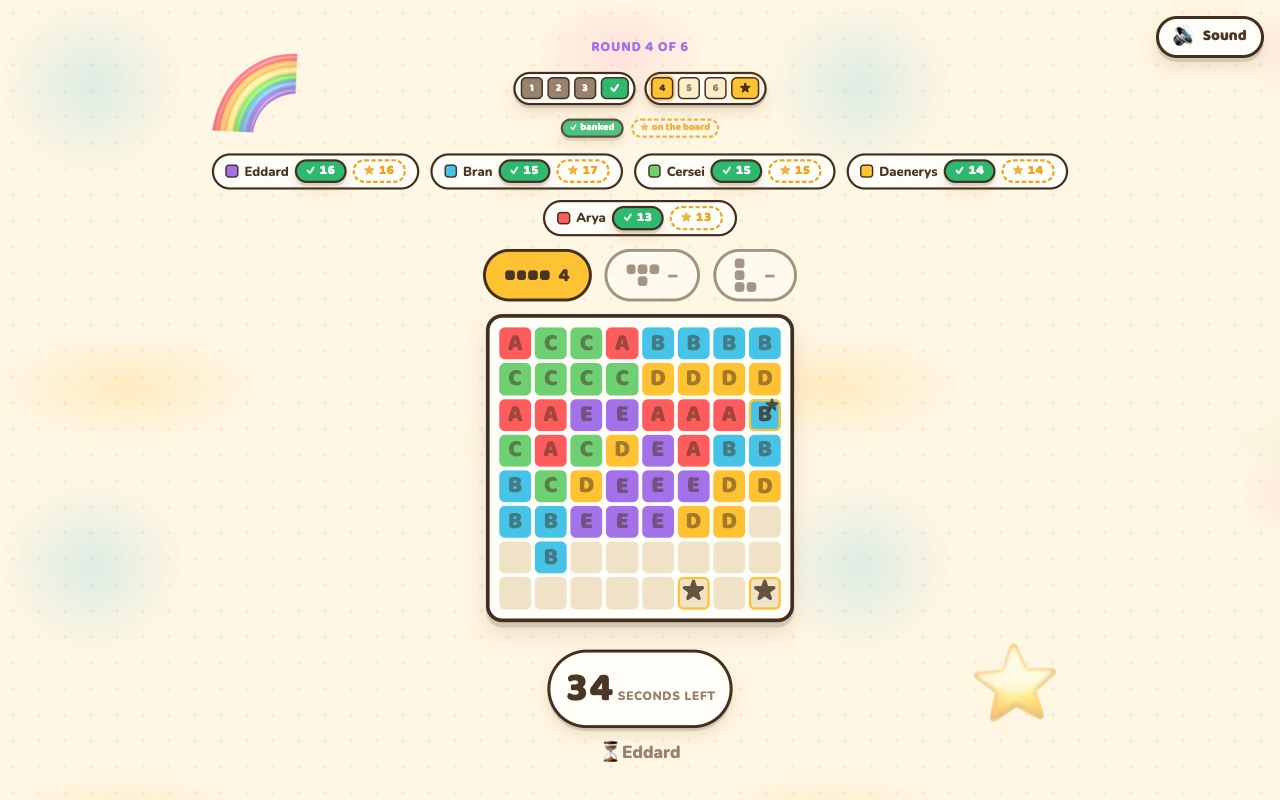
Three cards are dealt to the table, not to hands — the same three for everybody, shown on the TV and on every phone. Nobody has a better shape than anybody else, and more usefully: you know exactly what your opponents can play.
Every card in the deck covers exactly four squares:
Pick one, turn it, drop it
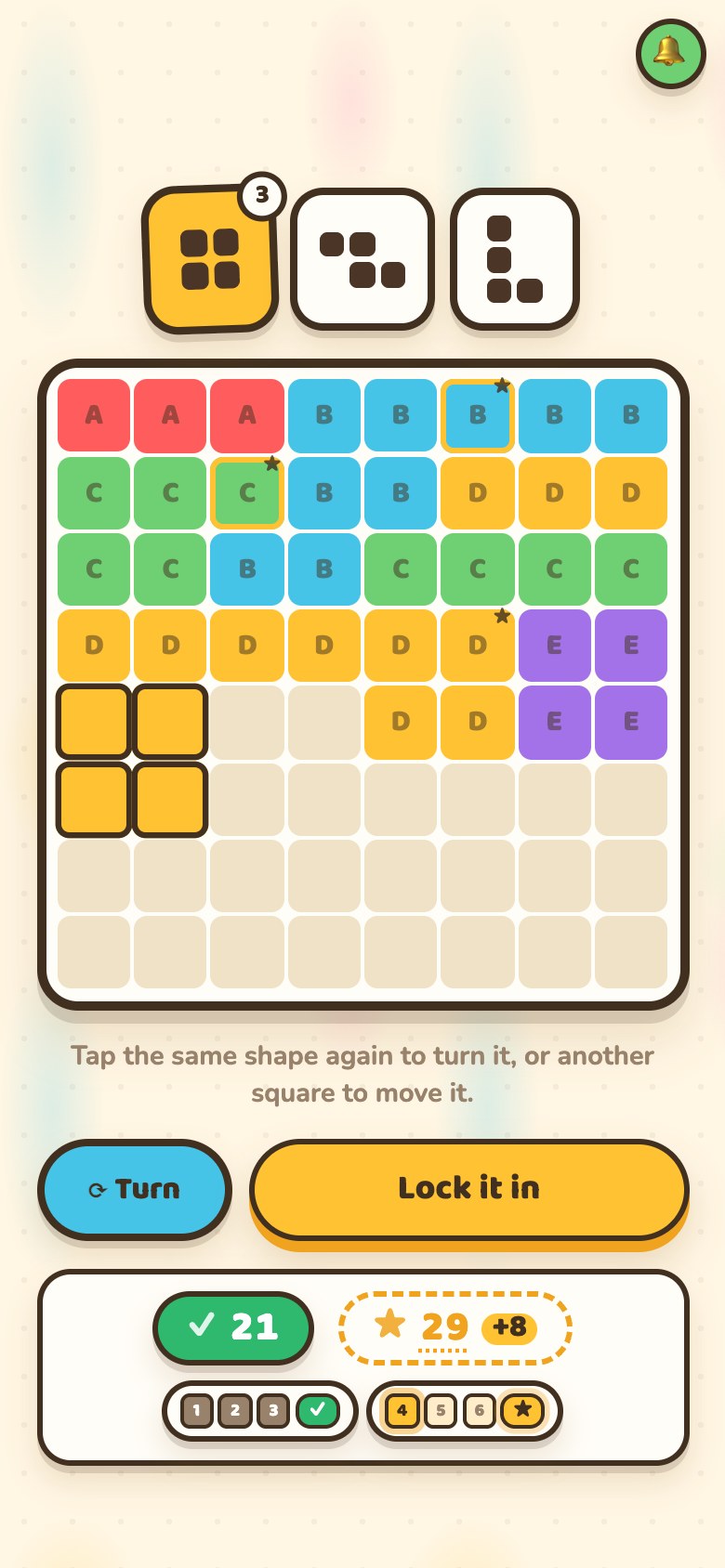
On your phone: tap a shape to choose it, tap it again to turn it a quarter-turn (or use the Turn it button), then tap the square you want it dropped on. The preview shows exactly where the paint will land, in your colour.
The same card, turned four times. Tapping the shape you already have selected is the fastest way to spin it while the clock is running.
Under the grid are your two numbers, and neither carries a label. The solid green ✓ coin is what you have banked — paid out at a count, and safe whatever happens next. The dashed gold ★ coin is what the board is worth to you right now, which is not a score yet: it's what the next count pays if the board still looks like this when it arrives. Same two marks as the count track underneath them — a payout that has been made, and one still to come.
The star coin is live. Move your shape and it counts what the move would be worth if all four squares land, so you can shuffle a card round the board and watch the number rather than doing the arithmetic. Two squares out of the middle of your own block is worth more than four in the far corner, and the coin will tell you so before you commit. Painting ground you already hold reads +0 — which is exactly what defending costs you.
Lock it in — before the clock does
You get 45 seconds, and you can keep moving your shape right up until the round closes: locking in early doesn't commit you, the button just changes to Move it. The round ends the moment the last player is in, so if everyone's quick you never see the clock run down.
Sending it does cost you something, though. Under the three cards, both screens count how many people have committed to each shape — so the moment you lock in, the table knows which card you took. Never where: your square stays yours alone until the reveal. Going early buys you a settled move and spends the only secret you had.
If the clock beats you, your shape doesn't go down at all — and you can still have squares taken off you while you're not looking. Nobody ever sits a round out.
Everything lands at once
All the shapes resolve together, square by square. A square exactly one player went for takes their colour. A square two or more went for turns to mud — unless one of them is the player who already held it, who keeps it. The rest of your shape still lands either way: a collision costs you the squares you clashed on, not the whole move.
The rule everything hangs on
How mud works
Cersei is holding two squares in the middle. Arya goes for them with the square card; Bran goes for them with the line. They've picked different shapes and different anchors, but the two of them overlap on exactly the squares Cersei had.
Arya keeps the two squares nobody contested; so does Bran. The two they both wanted are mud. And notice what happened to Cersei — she wasn't in the argument at all, and she lost both her squares to it. Mud strips whoever held the square before, which makes a collision the one way to take ground off somebody without having to hold it yourself.
The other half of that rule
Holding what you've got
A square's own owner doesn't count as one of the people fighting over it. So if you drop a shape on ground you already hold, and somebody comes for it that same round, you keep it and they get nothing. Same round, same square, no mud.
Cersei guessed she was about to be attacked and repainted her own two squares. Arya went for them. Cersei holds both — they wear a double rim on the reveal — Arya's other two squares still land, and the two she aimed at are spent on nothing: no mud, nothing changed hands, half her shape simply gone.
But a defence only sees off one attacker. Two of you going for the same square beats it, and the defender loses it along with everybody else:
Cersei defended again, but this time Arya and Bran both came for the same two squares. Three painters on one square is mud whoever they are — so Cersei loses the squares she was protecting, and neither attacker gets them either. Which is the balance of the whole rule: you can't be robbed by one person who guesses right, and you can't be safe from two.
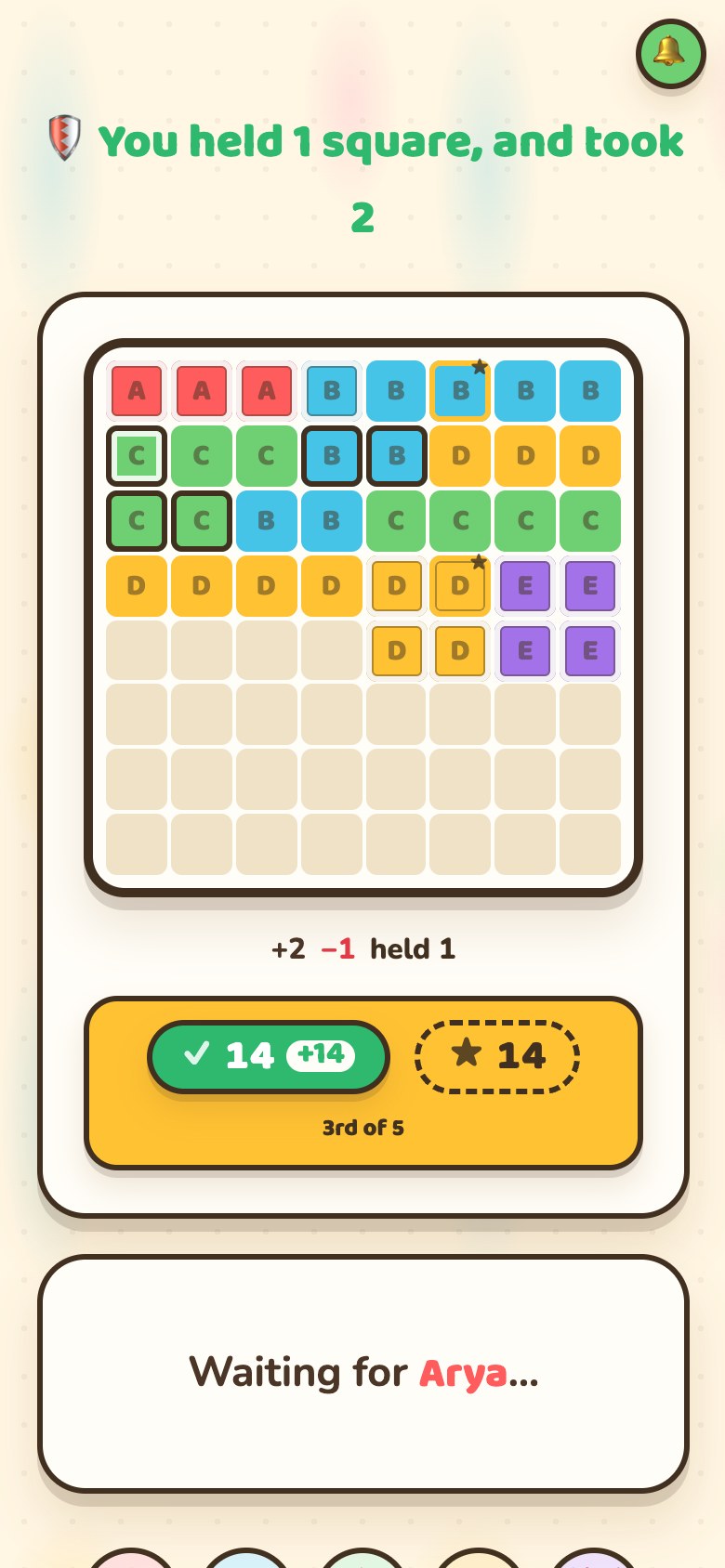
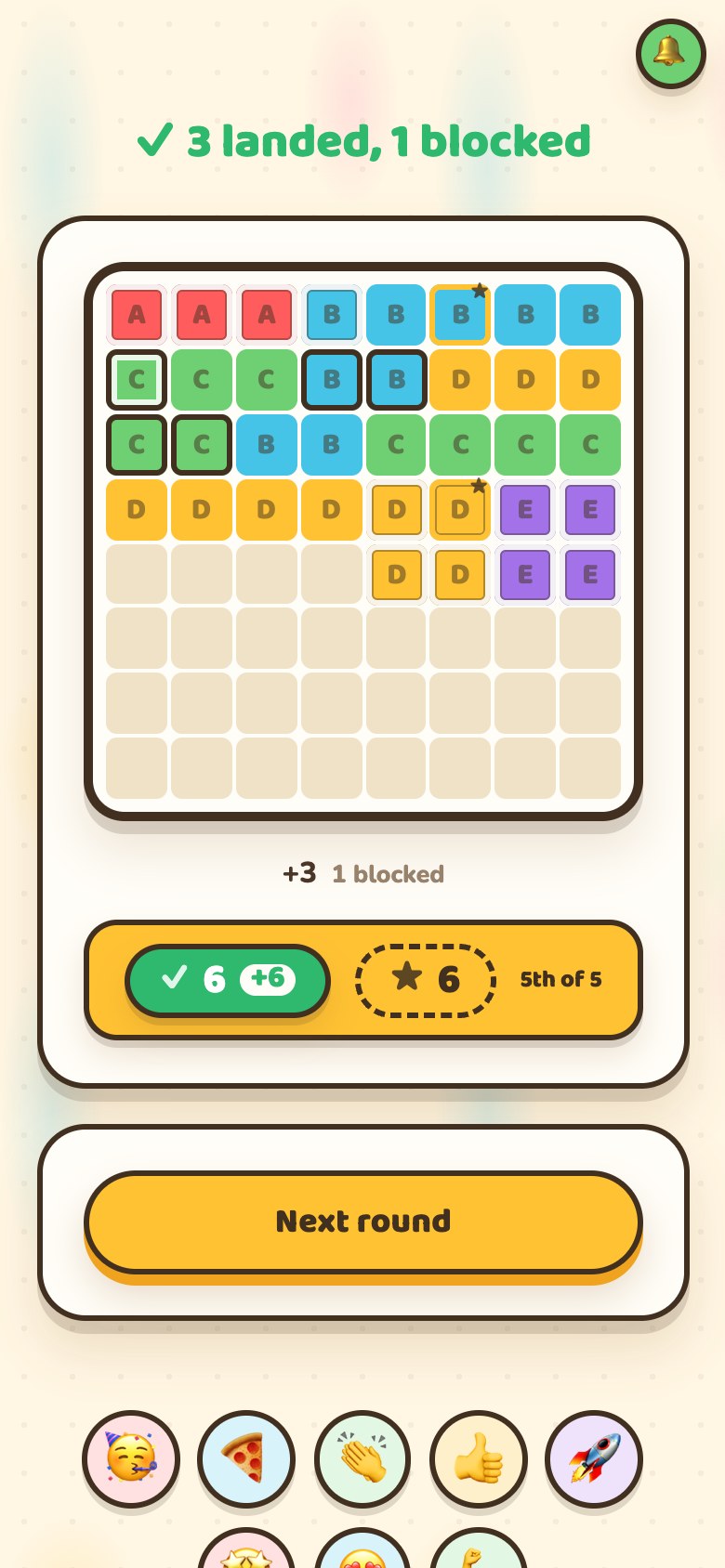
Two phones from the same real round, on a count. A blocked square is never called mud on either screen: nothing churned and nothing moved, and sending Arya looking for a collision that didn't happen would be a lie about who stopped her. Note that Cersei's headline and her numbers disagree, and both are true — she held the square somebody came for, and still went backwards one elsewhere while she was busy holding it.
And it costs you to try. A shape spent defending four squares is a shape that didn't take any new ground — so guessing wrong is a whole turn thrown away, and guessing at all means picking four of the dozen-odd squares you hold and hoping. Defend the ones worth defending: a star, or the square in the middle of your block.
Scoring
What a square is worth
The board is counted every 3rd round, and what you're holding at that moment is banked — added to a total you keep for the rest of the game, whatever happens to the squares that earned it. Squares don't score on their own; they score at a count. Which means ground is worth what you can hold, and holding the same patch through three counts pays you for it three times.
A count is three things added together.
So where you paint matters as much as how much of it lands. These two players hold exactly eight squares each:
Eight squares apiece, four points apart. Keeping your paint together is worth roughly as much again as taking more of it.
Which tells you where to attack. A square out of the middle of somebody's block doesn't just take a square off them — it snaps the block in half:
One square, four points — where the same square taken off the end would have cost two. The cheapest attack in the game is a single square in the right place, and it's usually not the one that looks juiciest.
The gold rings
Star squares
Two stars are on the board from the first shape, and a third appears two thirds of the way in — wherever it lands, including on top of paint somebody already has. They're worth three each, they're never close enough together for one card to cover two, and everybody can see them all game.
They exist because a bare grid gives you no reason to paint here rather than there. A star is that reason — and it's the one square on the board where going for what somebody else is obviously going for is worth the risk of mud. And a star pays at every count it survives, so one taken early and held is worth far more than its three points suggest.
Two players
The Grey
With exactly two of you, a third painter joins: the Grey. It puts down one shape a round like everybody else, its squares are slate grey and marked G, and they score for nobody.
It's there because mud needs three. In a duel, two players going for the same square lose the same amount and nobody profits, so a pair quickly learns to keep out of each other's way — and the game quietly turns into two people painting separate corners. A third brush gives you something to run into, something to deny, and something to blame.
It plays a rule, not a whim, and the rule is on the TV: bare ground first, stars whenever it can reach one, and the biggest blocks once the board fills up. Being in front only matters to it as a tie-break — it won't hunt the leader, it just looks their way when it's otherwise indifferent. Both screens tell you which card it's holding before you commit; where it's putting that card is the part you have to work out.
And it is not above the rules. Paint the square the Grey is painting and you both get mud; paint over its ground on a later round and it's yours. In a duel, the Grey is usually the biggest single holding on the board — which makes taking a bite out of it the safest four squares available, because it can't take them back on purpose.
Arya is on five squares, Bran on five, and the Grey is sitting on seven of the board and one of the stars. Neither player can win by tidying their own corner: the points are in the grey.
Reading the TV
What the reveal is telling you
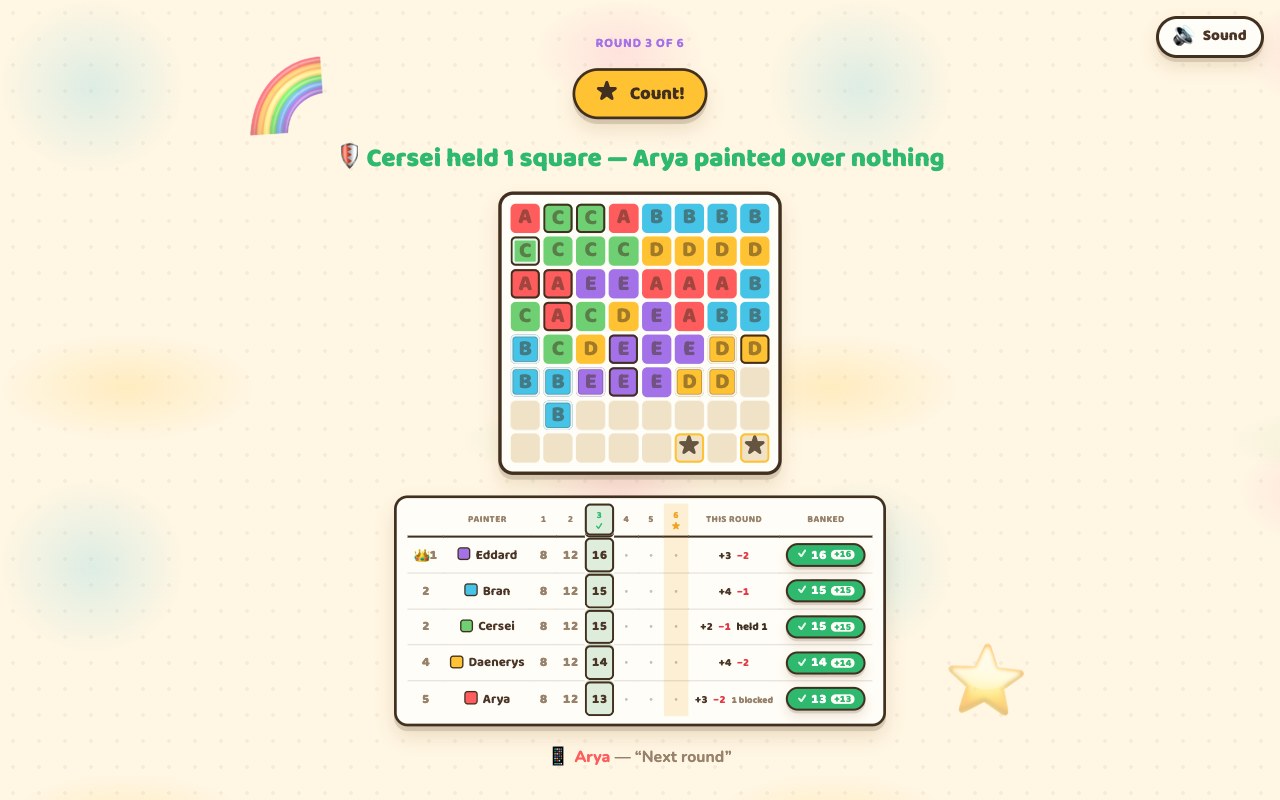
The This round column is each player's round in a handful of characters. Arya's reads +1 · 2 blocked · 1 to mud: she played the four-square line straight across the middle, two of it ran into Cersei defending and were spent on nothing, one collided with Bran's line and churned, and exactly one square changed hands to her. Cersei's reads −3 · held 2 — she gained nothing whatever, lost three squares elsewhere, and still had the best-defended block on the board. Blocked and mud are counted apart on purpose: a blocked square never churned and never moved, and sending somebody looking for a collision that didn't happen is a lie about who stopped them. A green number on its own always flatters you — once the board fills, a shape that lands perfectly is often still a net loss.
The rest of the table is the whole game in columns: a column per round, holding what each player's board was worth at the end of it. The counting rounds are tinted, because those are the only ones that actually paid, and the Banked coin on the right is exactly those tinted cells added up — 26 and 27 make Arya's 53. The round that has just landed counts itself up from the one before, so what you watch on a reveal is everybody's number moving; on a counting round the coins are then paid a beat later, which is the only moment in the game where points stop being provisional.
Winning
How it's scored
Whoever has banked the most when the last count pays wins. The counts land every 3rd round — after 6 rounds that's 2 payouts, after 12 it's 4 — and the last round of the game is always one of them.
Two players who bank the same total are separated by ground: what their board was worth at the end of every round, added up — the Ground column on the last screen. Since a tie on the bank means they were level at every count, that comes down precisely to the rounds in between, which is the fairest thing left to ask: who was holding more of the board while nothing was being counted. Level on that too and they genuinely share a place.
So the round to think hardest about is the one that pays. Nothing on the board is safe: the leader's block can be cut, their star can be taken, and four squares in the right place the round before a count can move more than four points. What is safe is everything already banked — which is why taking a square off somebody is worth most when you do it early enough to cost them a payout, and worth nothing at all the round after the last one.
The TV keeps the whole thing on one table: a column per round of the game, all of them from the very first screen, with the counting rounds tinted and ticked as they pay. Nothing is hidden and nothing has to be remembered — the schedule, everybody's history and the arithmetic behind every total are the same picture. Your phone carries the short version under the grid: your two coins, and the same track of rounds and payouts.
The last screen doesn't draw the grid. The board you won on is a picture of one moment, and it doesn't explain the totals above it — the reveal a tap earlier showed you the same grid with everything that happened to it marked on. Its place goes to three awards, picked from a much longer list of things the table has no column for: who took the most squares off other people, who defended best, who kept collecting stars, who was quickest to lock in, whose whole shape kept disappearing into the mud. Every one shows the number it was won on, and an award nobody earned is never handed out — a quiet game gives out three real ones rather than filling the shelf. You'll see a different three next game.
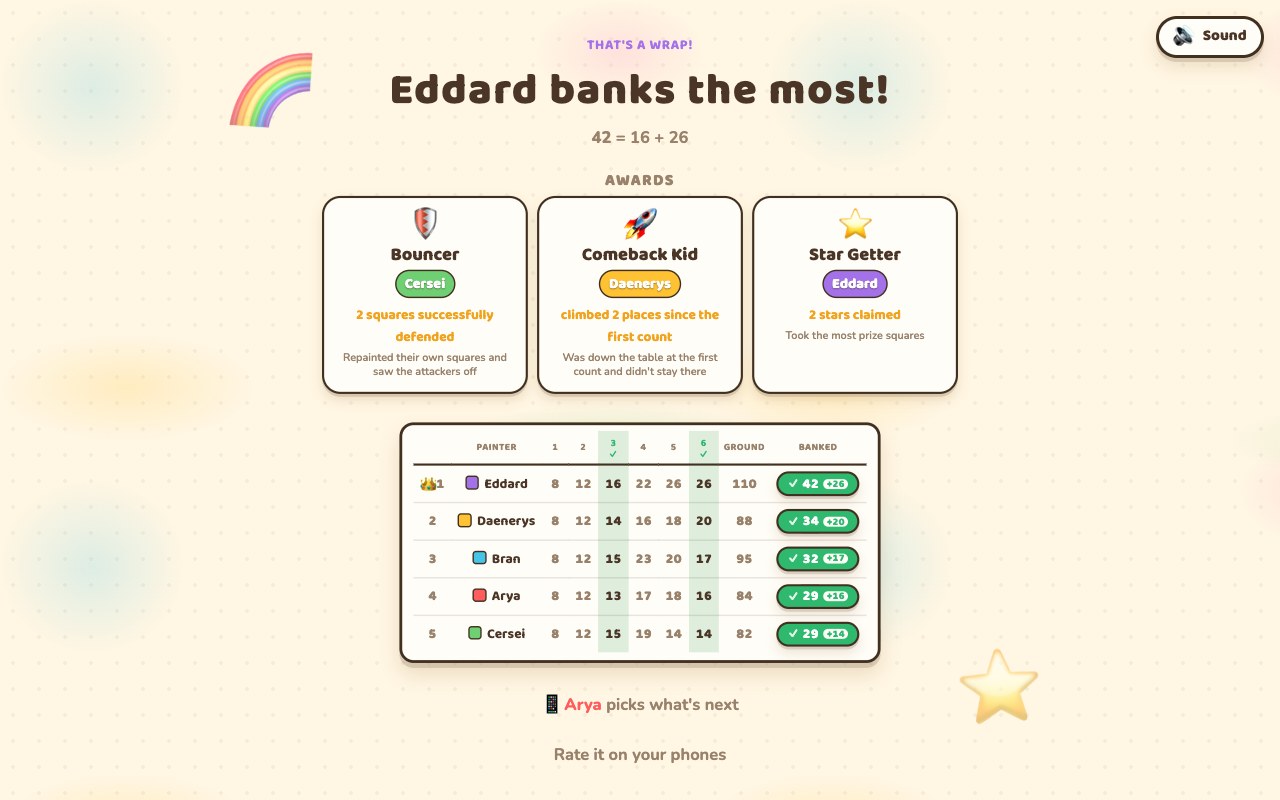
Five players, six rounds, two counts. Every coin on the right is the two tinted cells on its row added up — Eddard's 16 and 26 make 42, and the line under his name prints exactly that. Where two players finish level on the bank, the winner is decided on ground: every round's board value added up, which is the column beside the coins and the only place the tie-break shows its working. Then the three awards, for the things the table has no column for — Cersei saw two attacks off, Daenerys climbed two places after the first count, and Eddard took both stars.
Tips
Playing it well
The obvious square is worthless
The best-looking spot on the board is the one everyone else is also looking at — and if two of you take it, nobody does. Half of playing Turf well is spotting the square that's about to be a fight and going somewhere else.
You can see their hand
The three cards are the same for everybody. So when the leader has a big square block with one gap in it, you know precisely which shape fills it and whether it's on offer this round. Play against what they can do, not what you fear they might.
Colliding on purpose is a real move
If you go for the leader's block and somebody else does too, you both get nothing — but the leader still loses the squares. When you can't win, denying is the next best thing, and it costs the other attacker exactly as much as it costs you. It's also the only way through a defence: one attacker gets seen off, two don't. The square the leader is most likely to be guarding is the square worth bringing a friend to.
Paint anywhere. Really anywhere.
There's no rule that your shape has to touch your own territory. New players build one careful blob and sit on it — but you can only defend four squares a round, and only the ones you correctly guess are under attack. Most rounds your shape should be somewhere else entirely; the far corner is as legal as the square next to you.
Being ahead is dangerous
A big lead is a big target — it's more surface for everyone else to paint over, and you can only add four squares a round. Expect to be attacked from the moment you're in front. You can't spread out to hide, though: a scattered holding throws away the patch bonus. Stay in one piece, and spend the odd round repainting the middle of it — one attacker bounces off, and the round they bring a second one is a round they're not painting anywhere else.
Cut, don't nibble
Against a big block, the square that hurts is the one in the middle. Taking the end of a five-run costs its owner two points; taking the centre costs them four and leaves you the same square either way. Look for the join — the one square holding two halves together.
The last round decides it
Because anything can be painted over, leads swing wildly right to the end — a player in front by five can finish last. Don't spend the final round tidying up. Take the biggest block you can off whoever's winning.
Paint your own squares on purpose
Dropping a shape on ground you already hold gains you nothing — and if somebody comes for that ground the same round, it's the only way to keep it. Defend the square you'd hate to lose, not the biggest block you own: a star you're sitting on, or the join holding your patch together. Guess wrong and you've thrown a turn away, which is exactly what makes guessing right worth watching for.
Mud gets commoner with a crowd
With three or four players, collisions almost never happen by accident — mud is a weapon you choose. With seven or eight, the board is a scrum and you'll clash without meaning to. Play tighter at a small table, and expect chaos at a big one.
The stars are the map
Three points is most of a shape's worth, sitting on one square that never moves. Take one early and you'll spend the game defending it; take one on the last round and nobody can take it back. Watch for the third star arriving two thirds of the way in — it often lands on somebody's paint and turns a quiet corner into the loudest square on the board.
In a duel, read the Grey
Its card is public before you commit and its rule is published — bare ground, then stars, then big blocks. Early on it's competing with you for empty space, so let it have the far side. Late on it's the biggest holding going, and it never retaliates — and it never defends, either, so its squares are the one holding on the board that can always be taken with a single shape. The safest four squares going are usually the Grey's.
In short
The eight things to remember
- Everyone plays every round, at the same time.
- Same three shapes for the whole table — the square is the decision.
- Two people on one square makes mud, and mud belongs to nobody.
- Repaint a square you hold and you keep it — against one attacker, not two.
- You may paint over anyone, anywhere, right up to the last round.
- Keep your squares touching — your biggest patch counts twice.
- ★ squares are worth three; the third one turns up late.
- Most points when the last round lands wins.