Eldoria · a party game for the TV
How to play
Letter Rip
A block of letters goes up on the TV and everybody writes at once, against the clock. Use the letters in any order for a point, or side by side in that order for a lot more — but a word somebody else also wrote is worth nothing to either of you.
The whole game in one picture
Three letters, four ways to go wrong
The block is TRA. Five people wrote a word for it at the same time, without seeing each other's.
CONTRACT has T-R-A sitting together in that order, so it's worth the length of the block: 3. GUITAR only has the three letters somewhere, so it's worth 1. And then there's the interesting bit — EXTRA was a perfectly good in-order answer worth 3, and two people wrote it, so it's worth nothing to either of them. Bolting an S on doesn't get you out of it.
Setting up
Getting everyone in
Open Letter Rip on the TV
Room code and QR code on the TV, as usual.
Everyone joins from their phone
Scan, name, in. There's no turn order to worry about here: nobody has a seat and nobody sits a round out. Everybody writes every round, which is why this one works with a crowd — eight people take exactly as long as two.
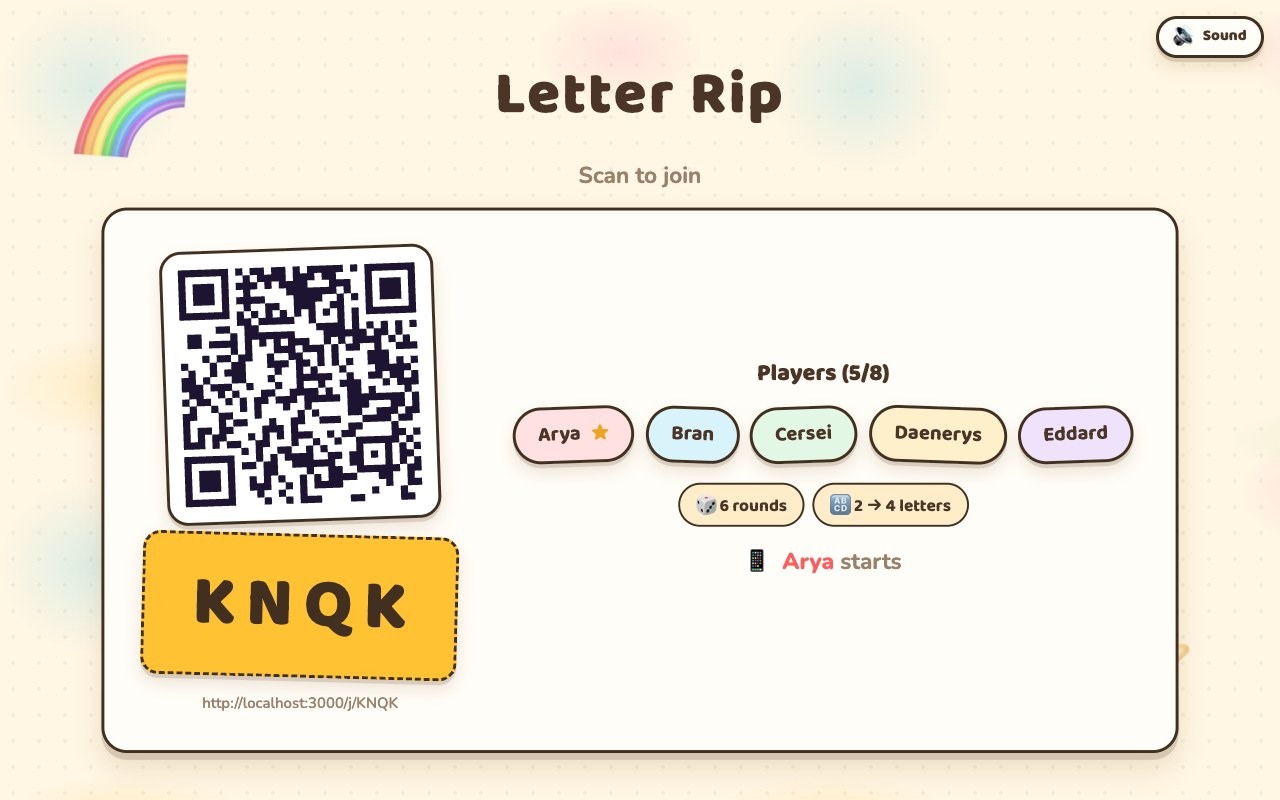
The host picks a length and starts
6, 10 or 14 rounds. Because everybody plays every round, the count is purely about how long you want to be here — and about how fast the blocks get harder, since the ramp from 2 letters to 4 is spread across whatever length you chose.
After that the host has almost nothing to do: the writing phase runs on a clock, not on their thumb.
The loop
What happens in a round
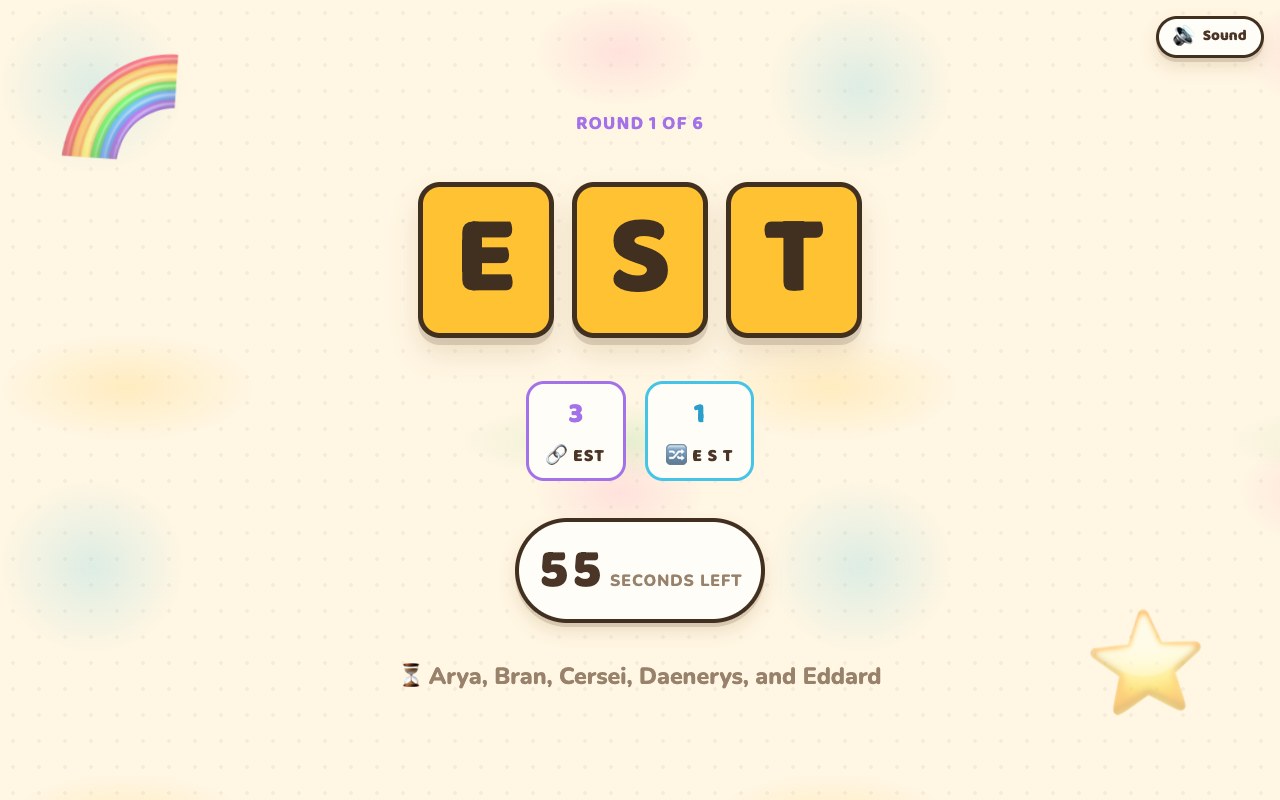
The block goes up, and the clock starts
Two to four letters, the same for everybody, on the TV and on every phone. You get 60 seconds — but the round closes the moment the last person is in, so a quick table never sees the clock run down.
The blocks aren't random letters. They're drawn from a list that's been checked in advance, so you never get a round that's simply impossible.
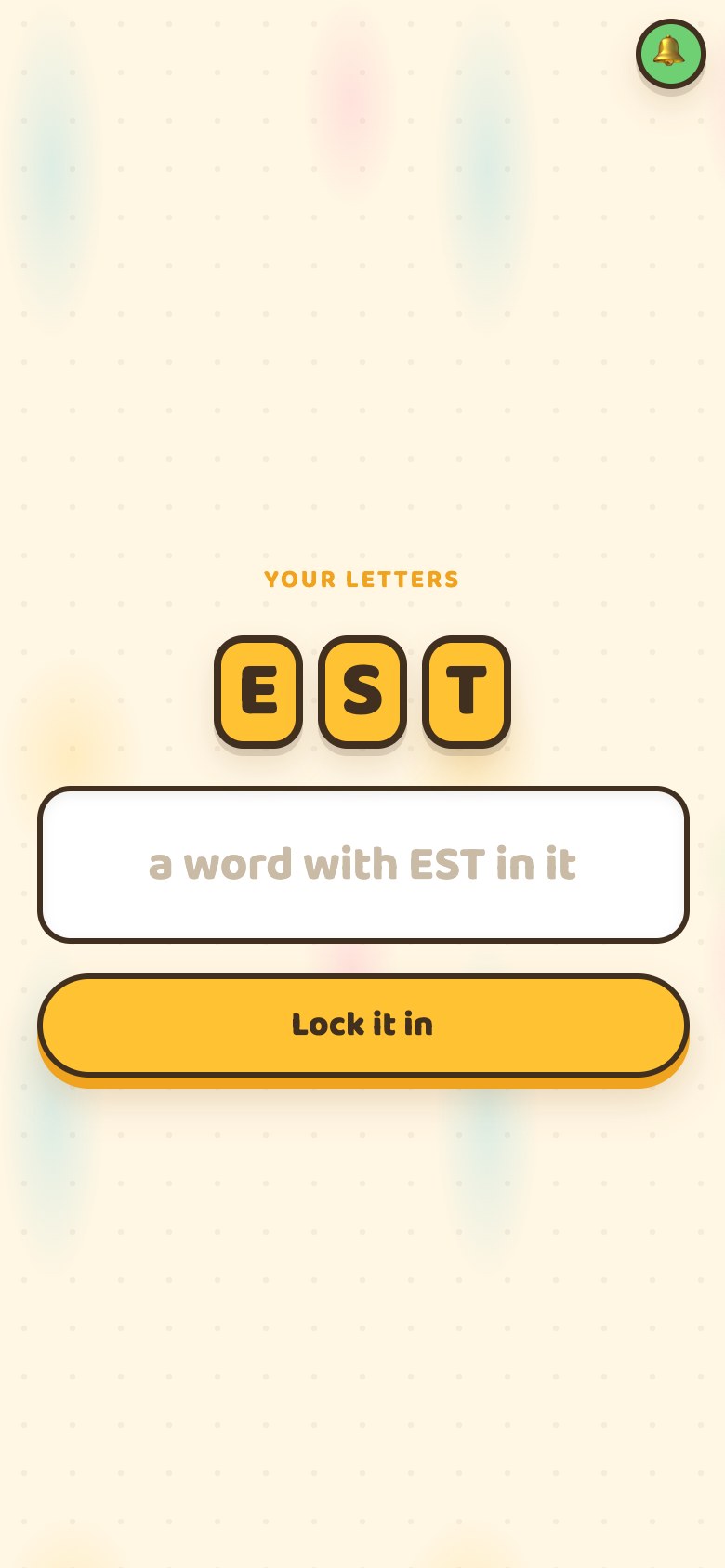
Write one word and lock it in
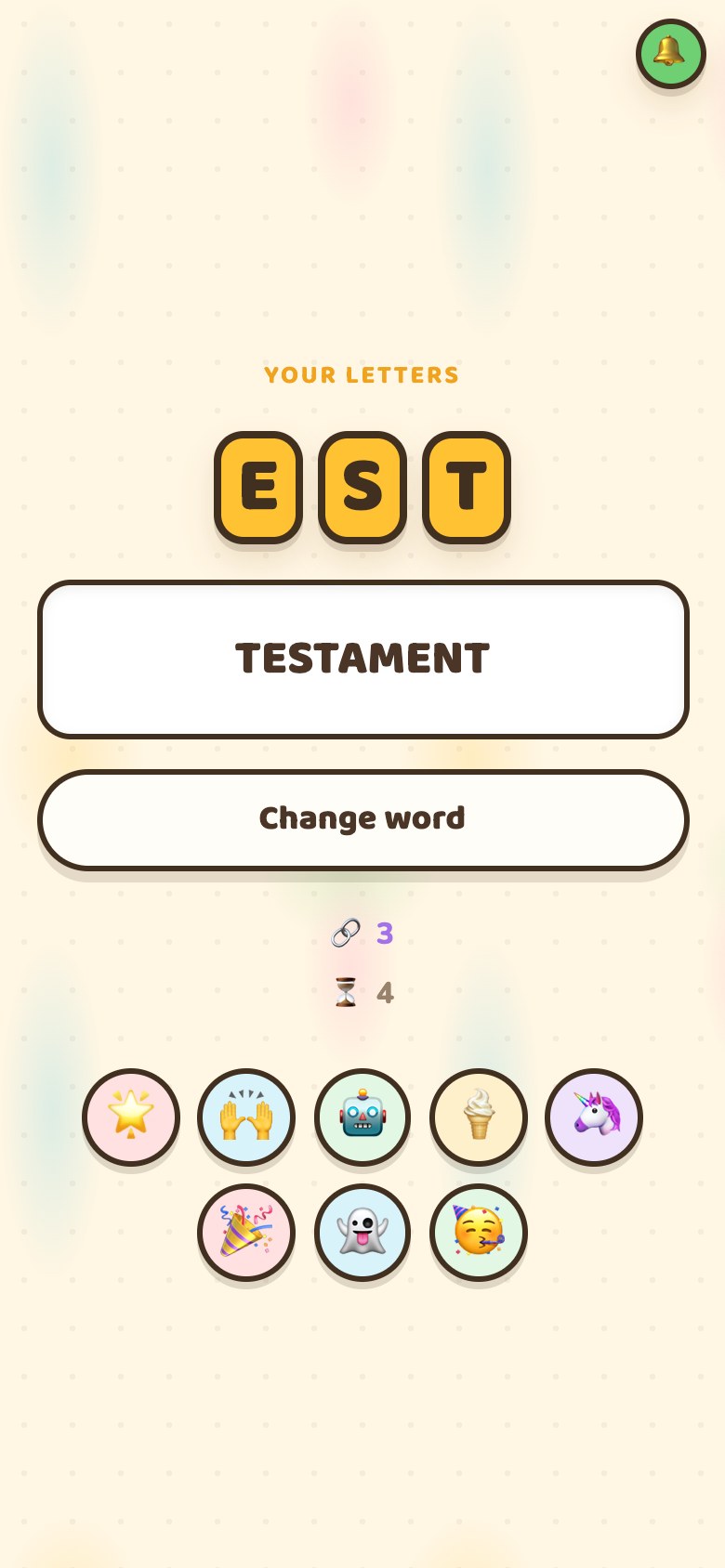
One word, hyphens fine, at least 3 letters, up to 24. Once it's in, your phone tells you whether you've got the letters in order or merely present, and what that's worth — the one thing about your word that's pure arithmetic, so it's fair to show you. What it won't tell you is whether it's a real word, or whether anyone else has written it.
Locking in isn't final. The button becomes Change word and you can rewrite until the round closes.
Everything is judged at once
When the round closes, every word is checked against the letters, against the dictionary, and against everybody else's word — all in one pass, so a collision takes out both copies at the same instant. Then the whole board goes up.
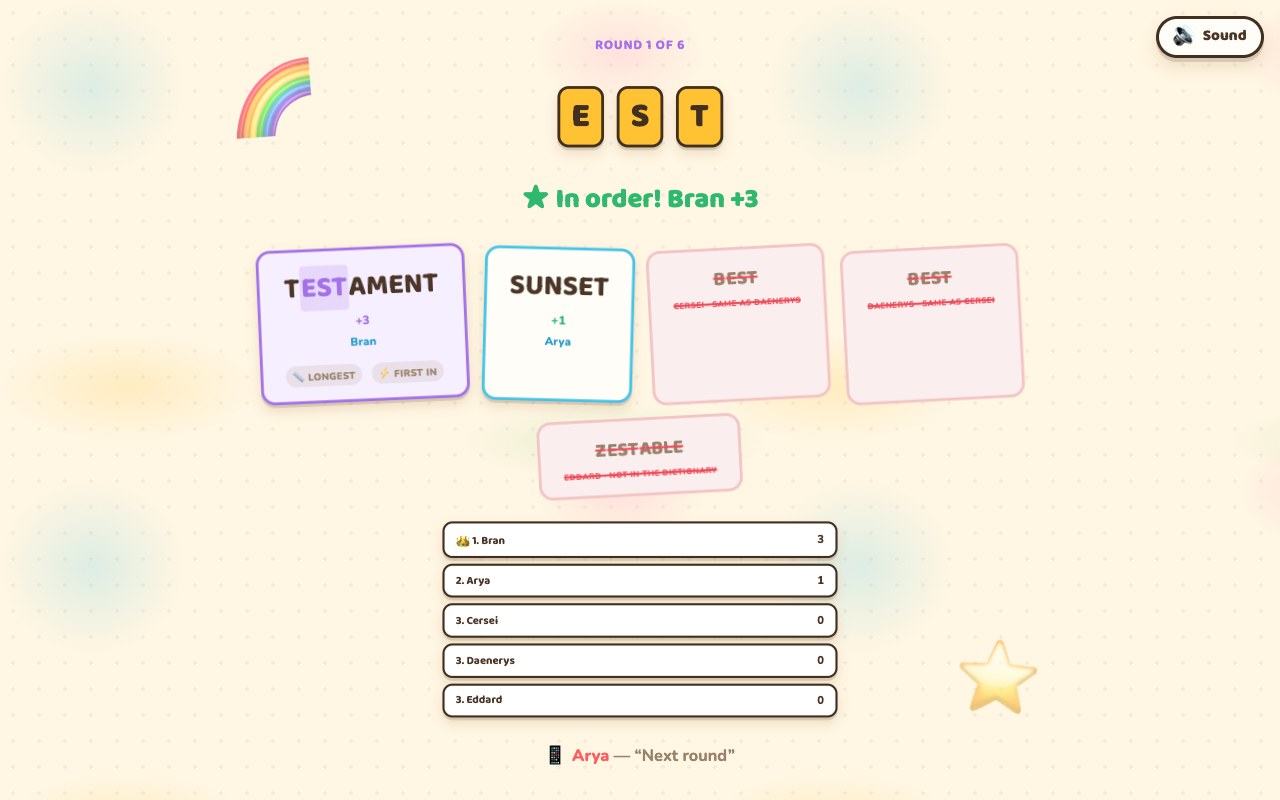
The two badges — longest word and first in — are worth exactly nothing, deliberately. Paying for length would reward dodging collisions with an obscure monster, and paying for speed would reward firing off the obvious word, which is the one thing the game is built to punish.
Scoring
Two ways to use the letters
The one point is a floor rather than a tier: whatever the block, a safe unique word banks something, so nobody sits on nothing all night. The in-order payout is where the game lives — and note that it grows with the block, because a longer block is harder and worth more at the same time.
| The block | Any order | In order |
|---|---|---|
| 2 letters | 1 | 2 |
| 3 letters | 1 | 3 |
| 4 letters | 1 | 4 |
And a word gets nothing if it doesn't use the letters at all, if it isn't in the dictionary, or if somebody else wrote it too. There's no penalty beyond the zero — a wrong answer costs you the round, not points off.
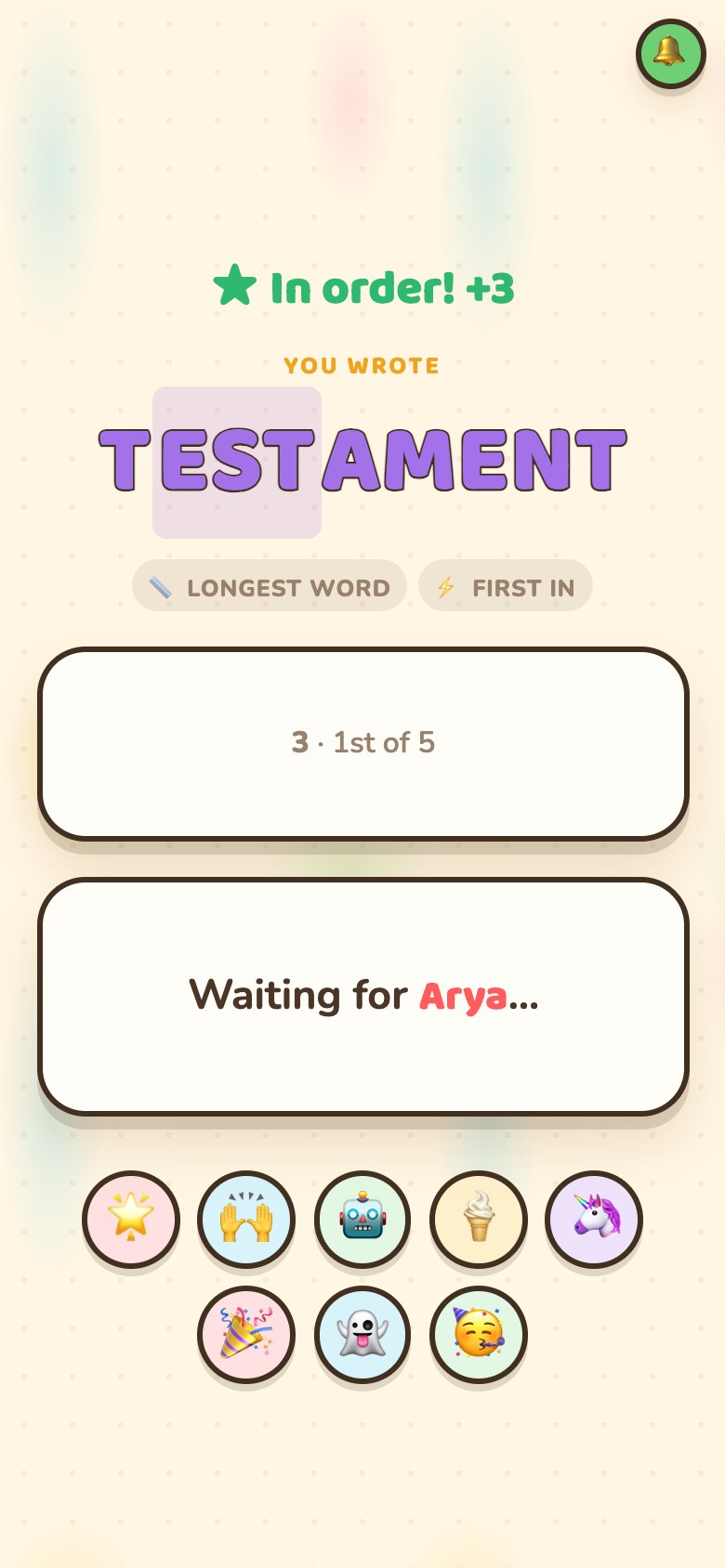
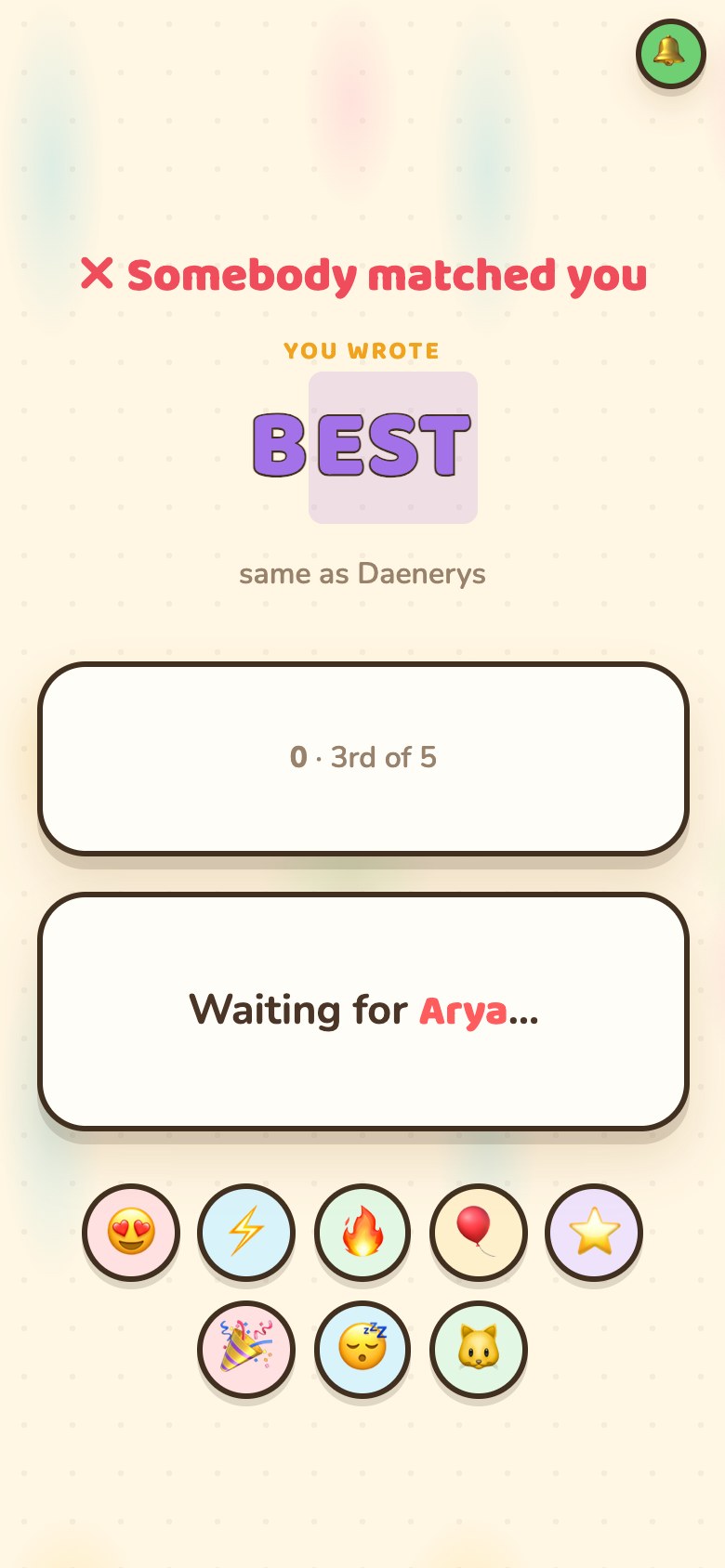
The rule everything hangs on
What counts as the same word
Not just identical spellings. Two answers collide when they're the same word inflected or misspelled — otherwise everyone would simply add an S to the obvious answer and the rule would do nothing. What matters is the front of the word: answers that agree on their opening and differ near the end are one answer. Ones that part company early — anagrams especially — both stand.
| These two answers | Collide? | Why |
|---|---|---|
extra · extra | Yes | The same word. |
extra · extras | Yes | One is the other with an ending on it. |
trap · traps | Yes | Same stem, difference all in the tail. |
extra · extract | Yes | Built on the same opening — near misses count too. |
rat · tar | No | Same letters, different words. Both score. |
art · tar | No | Anagrams are separate answers. |
strap · scrap | No | One letter apart, but they part company at the front. |
traffic · contract | No | Two different words that both hold the block. |
Which means an anagram is a genuinely good hiding place: on the block TRA, rat, tar and art are three different one-point answers and all three can score in the same round.
Arguments, settled
The dictionary and the host
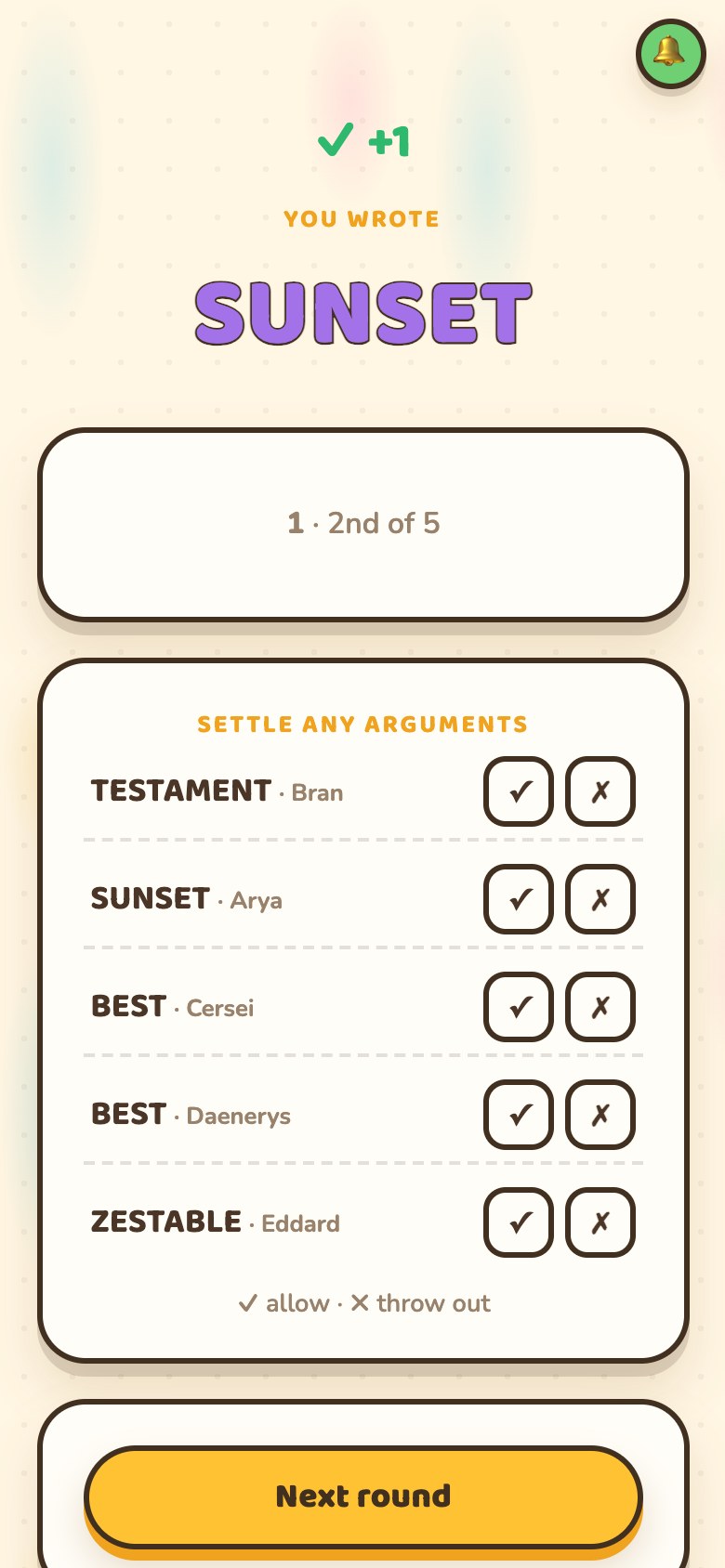
Words are checked against a big, deliberately permissive list — around 172,000 entries. A big list means fewer “that IS a word!” rows, and the junk it lets in is handled the other way round: on the reveal screen, the host can overrule any word in either direction, waving through the one the table agrees is real and striking the Scrabble junk nobody will accept.
Overruling re-scores the whole round from scratch, collisions included — so a word the host lets back in can go on to knock somebody else's identical word out.
One thing no button can touch: the letter rule. A word that doesn't use the block isn't a matter of opinion, and there's no override for it.
The arc of a game
The blocks get harder
Round one is 2 letters and nearly free — and only worth 2. By the end you're staring at 4, which is a wall, and worth 4. Length is the difficulty and the payout at the same time, so they climb together.
Which also changes what a collision costs. On a two-letter block everyone can find an in-order word, so the field is crowded and matching somebody is likely. On four letters, half the table will settle for the one-point answer — and the person who finds an in-order word usually finds it alone.
Tips
Playing it well
The first word you thought of is everyone's word
On TRA, half the table writes extra. It's a perfect answer and it's worth nothing. Spend two seconds finding the second word you thought of — that's the one that scores.
Always send something
A safe, unique, any-order word banks a point, and a blank banks nothing. If the clock is going and you haven't got an in-order answer, put the ordinary word in — you can still change it if inspiration lands.
Long words hide better
Not because length pays — it doesn't — but because nobody else is writing infiltrate. The obvious in-order answers are short and everybody can see them; the collision risk drops off a cliff after seven letters.
Anagrams are free real estate
rat, tar and art don't collide with each
other. On a short block where every in-order answer is taken,
a scrambled word is a point nobody can take off you.
Watch the block's position
The letters can sit anywhere in the word: the start (traffic), the middle (contract) or the end (extra). Most people look at the start first, so the middle is where the uncontested words are.
Plurals don't dodge anything
traps collides with trap. If your only escape from the
obvious word is an ending on it, you're still in the collision —
find a different word instead.
Play the table, not the block
Two players is a duel and colliding is entirely on you. Seven or eight and every obvious word is gone before you've typed it, which makes the ordinary one-point answer much more valuable at a big table than a small one.
The host is the appeal court — use it
The list is permissive but not perfect. If a real word gets rejected, say so on the spot: the host can wave it through and the round is re-scored. Don't just take the zero.
In short
The six things to remember
- Everyone writes at once, every round, on a 60-second clock.
- Letters in any order: 1 point. Side by side in order: the block's length.
- A word two of you wrote scores nothing for either.
- Plurals collide; anagrams don't.
- The blocks get longer, and worth more, as the game goes on.
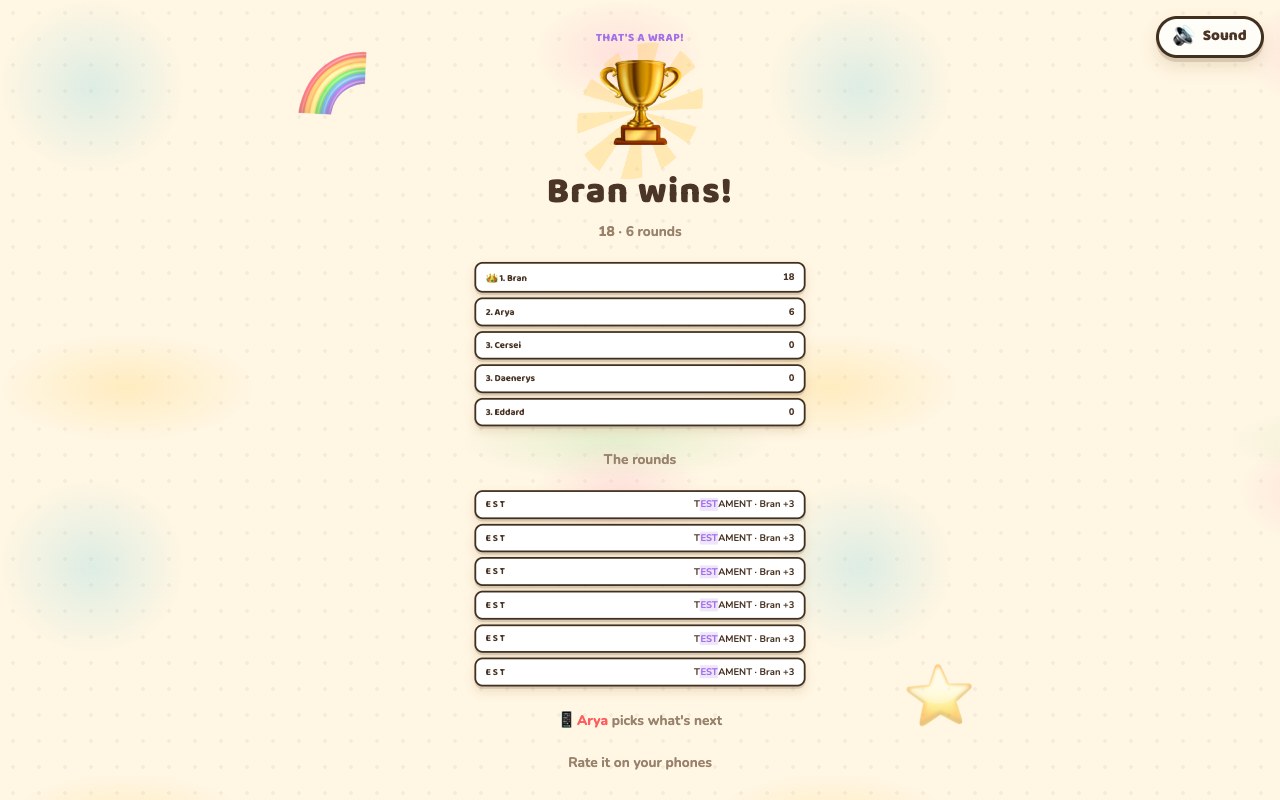
- Most points at the end wins.